

7 minute read
Smart insight and clear visuals that matter – what we’re watching now and how intention and conviction shape our portfolios.
Markets
As of Friday, April 17, 2026, Markets are up with the S&P 500 reaching a new all‑time high as investors look past recent geopolitical stress and price in de‑escalation in the Middle East. Optimism was supported by confirmation that a ceasefire between Israel and Lebanon is holding, and that Iran has reopened the Strait of Hormuz to commercial shipping, easing concerns around global energy supply disruptions. This, even as a U.S. naval blockade of Iranian ports remains in place and negotiations continue.
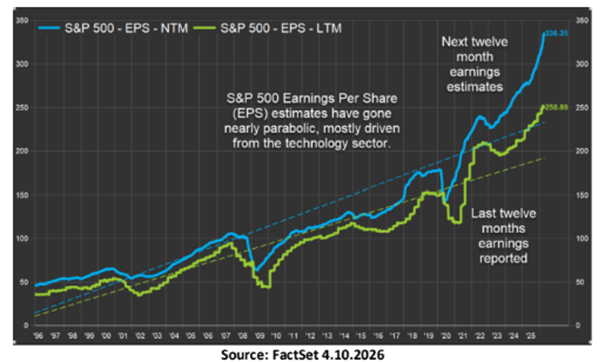
The chart below suggests next twelve-month (NTM) earnings per share estimates for the S&P 500 rising at a very fast rate led by the technology sector. These rises are not just in the US.
- The MSCI EAFE could rise from a blended estimate of 2% in Q1 to 19% in Q4 and 46% by Q1 of 2027.
- The MSCI Emerging Market index is forecasted to see earnings growth from 23% in Q1 to 70% in Q4.
The question remains; will these estimates be too high for companies to beat over the course of the year?
Real Estate
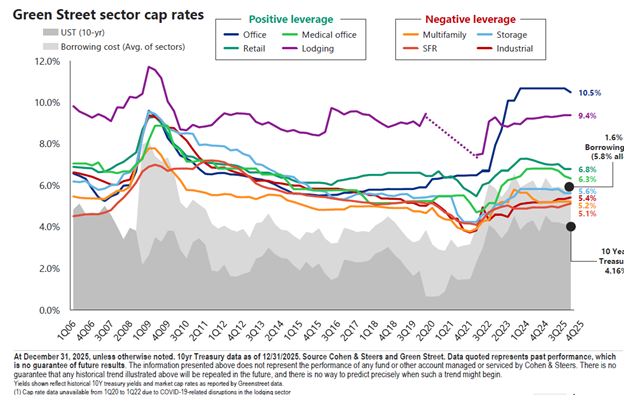
The chart below from Cohen & Steers and Green Street shows that many sectors continue to be priced at negative leverage for new investors (Cap Rate < Borrowing Cost) at current appraisals.
If new investors are buying legacy evergreen real estate funds, the portfolio cap rates may not reflect current market environment. As a result, new capital may be exposed to assets acquired at yields below today’s cost of capital. With cost of debt at 5.8% all in, new investors should consider buying at 5.8% + risk premium cap rates.
Tech
Software: Is Workday (WDAY) a signal of the bottom?
The market no longer treats software as structurally "special". For the better part of the last two decades, the group commanded premium multiples as software companies delivered a rare combination, durable 20% revenue growth, net retention rates well above 115%, gross retention in the mid-to-high 90s, and 70-80%+ gross margins that made every other sector look capital-intensive by comparison. The threat from AI has completely flipped the narrative.
It is helpful to remember that transitions are rarely smooth. In the mid-2000s, investors were equally skeptical of the Cloud/SaaS transition. Many questioned whether Total Addressable Markets (TAM) would ever expand or if margins would ever stabilize. It wasn’t until 2010, when Salesforce began signing nine-figure enterprise deals, that investor enthusiasm truly went mainstream. We may be in a similar "valley of doubt" today as we move from Cloud-native to AI-native architectures.
Recent price action suggests the market is beginning to hunt for value amidst the wreckage. While much of the software group has been decimated—with many names down 40-50% YTD—Workday’s (ticker: WDAY) recent relative outperformance is a signal worth watching. Workday’s resilience may be the first sign that the market is finally distinguishing between temporary margin pressure and long-term value.
.png?width=568&height=315&name=SaaS%20Index%20vs%20Infrastructure%20Index%20vs%20NASDAQ%20Composite%20(YTD).png)
Artificial Intelligence
As of March 2026, AI traffic to U.S. retailers’ websites rose by 269% over the previous 12 months, continuing the momentum seen during the holiday shopping season when AI traffic was up by 693%, according to new data released on Thursday by Adobe.
The change in traffic sources isn’t the only impact. AI visitors are converting better, engaging at higher rates, spending more time on sites, and driving higher revenue per visit reversing trends from only a year ago, when regular customers were worth more to retailers.
- In Adobe’s survey, 39% of people said they used AI for online shopping, and 85% said it improved their experience.
These findings are likely due to how AI helps people narrow down products to find what they need and tap into discounts.
.png?width=560&height=547&name=Growth%20in%20AI-Driven%20Visit%20Share%20(Retail).png)
.png?width=615&height=511&name=Monthly%20AI%20vs%20Non-AI%20Conversion%20Rate%20(Retail).png)
Biotech
Robust M&A
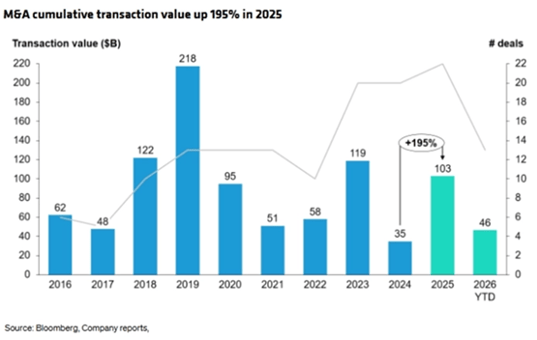
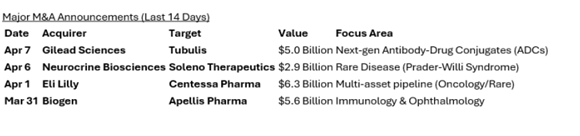
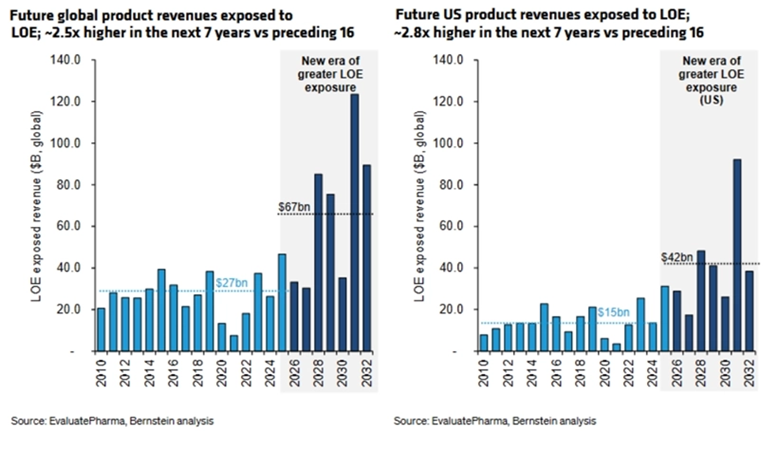
The biotech and biopharma M&A market has seen a massive surge in activity over the last two weeks, continuing a trend of "strategic portfolio-shaping" to combat looming patent cliffs. Total deal value in Q1 2026 reached over $46 billion, and the start of April has already added several multi-billion-dollar transactions to that tally. YTD, larger deals made a comeback, with three transactions over $10B in 2025 vs. zero in 2024.
Source: Bloomberg, company reports
We interpret these trends as reflecting (1) increasing pressure to solve for the slew of upcoming large LOEs (Loss of Exclusivity), and (2) A return to M&A activity after a “digestion year” in 2024 and the poor years of 2022 and 2023 – post COVID. We are moving into a new era of LOE patent exposure across the industry. We expect large-cap pharma to continue engaging heavily in M&A.
Inflation
The Rising Cost of Beef and Small Caps
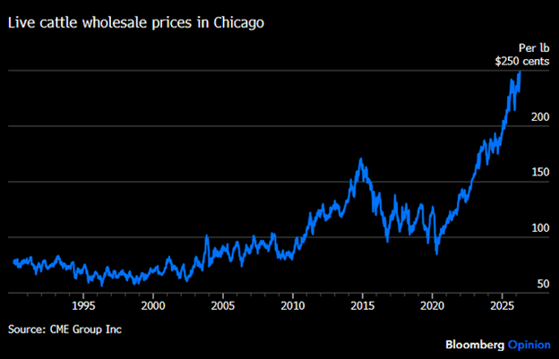
Takeout.com reports that compared to last year, the cost of beef to consumers is up approximately 16% across the board in 2026, according to data from the Federal Reserve Bank of St. Louis. Ground beef, steaks — you name it — are all up by double-digit percentage points. The former is averaging about $6.70 per pound, and those heroes of the grill can be a whopping $12.73 for the same quantity. Considering that a mere 5 years ago, in 2021, a pound of ground beef cost roughly $3.96, this recent increase represents an enormous hit to consumers. To really put that into perspective, over the 10 years prior to 2021, the cost of beef went up just $0.21.
A young money manager recently pitched a member of our team two stocks, one being Outback Steaks (Bloomin’ Brands) at 4x cash flow. The problem is that the market understands with 4x debt and this chart below, that Outback (along with their junior brands, Fleming’s) may have a terrible time just getting through the summer with their customers intact. The other issue is the massive distortions in the small cap indices being chosen from. A market stat from Jefferies states that through yesterday, Companies with No Revenue gained 114% in the R2 from April 8, 2025, and a whopping 220% in the R2V, while a bit less in R2G at 75%.
Economic Calendar: Week Ahead (Eastern Time)
Tues, 4/21 @ 8:30 PM: U.S. Retail Sales
@ 10:00 AM: U.S. Leading Economic Indicators
@ 10:00 AM: Pending Home Sales
Thur, 4/23 @ 8:30 AM: Initial Jobless Claims
Fri, 4/24 @ 10:00 AM: Consumer Sentiment (Final)
The Team Behind Friday Focus

Mary Ahn
Investment Research and Portfolio Strategy Manager

Cal Jones, CFA
Managing Director of Fixed Income

Eric Speron, CFA
Managing Director of Equities

Alton Tjahyono, CFA
Sr. Investment Strategist