

5 minute read
Smart insight and clear visuals that matter – what we’re watching now and how intention and conviction shape our portfolios.
Markets
The Margin Risk to the S&P
-
In the past 100 years, net profit margins in the S&P 500 averaged just under 6% and as low as 4%. Margins hung out in a stable way at 5-6.5% until the 90s when the economy grew out of automotives, steel and rails.
-
According to Chart A below, when the 90s hit, the margin line began its structural break upward during the dot-com boom. Scalable digital architectures began replacing physical footprints, allowing companies to grow revenues without matching expenses and taxes fell. After COVID, software as a service (SaaS) and the era of cloud computing, we saw a stiff step up to low double-digit levels for net margins.
-
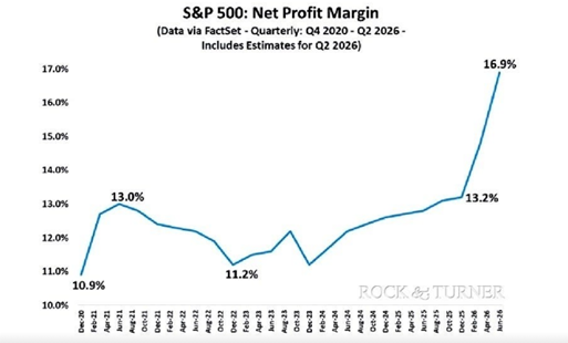
Since late 2025, we have seen a parabolic move up. Rock & Turner published an article on August 15, 2026 that we believe is worth circulating given its logic and the power of the argument. They note that hyperscalers and frontier labs are spending some $800B/year headed to $1T in 2027. They remind us that chip & memory companies see an immediate lift in sales and profits, while the spenders capitalize and depreciate it over 5-7 years. The mismatch inflates index margins now and reverses when the build-out slows, as vendor revenues fall while depreciation runs on.
Chart A
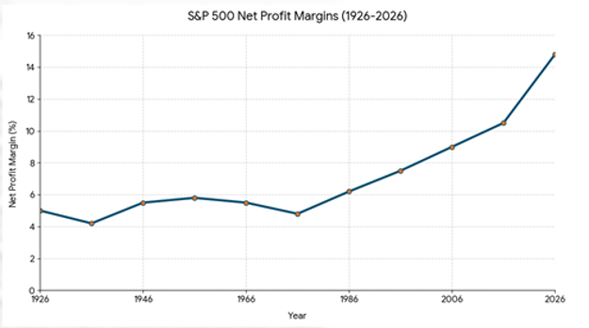
Chart B
Source: Rock & Turner
Rates
What’s Old is New Again
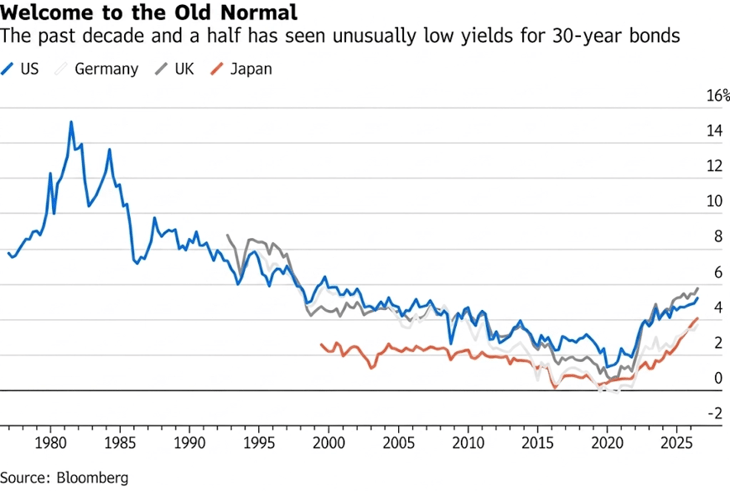
Deglobalization means countries have less need to manage currencies with foreign assets. Almost all countries face a bigger debt burden as their populations age and their social spending grows; hence we are seeing record debt levels not just in the US, but across developed nations. Bond bears have been waiting for this moment for about 15 years - ever since Mohamed El-Erian and Bill Gross coined and popularized the notion of the New Normal in reference to sluggish economic growth, subdued inflations, and low bond yields. Energy-driven inflation has jumped since the start of the Iran War, and confusion over Fed Chairman Kevin Warsh’s strategy to stay quiet and to let the market figure it out is adding to investor concerns and pushing yields higher.
As the global economy fragments, foreign appetite for sovereign debt reserves is steadily drying up. Concurrently, demographic headwinds and expanding social safety nets are inflating government balance sheets across the globe. For bond bears, this unwinds the decade-and-a-half "New Normal" framework pioneered by PIMCO’s Bill Gross and Mohamed El-Erian. Between an energy shock triggered by military confrontation with Iran and market confusion surrounding Fed Chair Kevin Warsh’s hands-off approach, the secular tide has turned and driven yields broadly higher across the curve.
While the old market adage warns against fighting the Fed, the true lesson today is that you cannot fight the long end of the bond market. Japan serves as a stark case study on the limits of financial repression; decades of capping long-term yields produced entrenched stagnation and severe market distortions. With inflation resurfacing, policymakers there face an unavoidable dilemma between rising debt-service costs and runaway prices. Ultimately, market forces dictate terms: if a government wants durably lower long-term borrowing costs, the only viable path is structural debt reduction.
Real Estate
Commercial Real Estate Finds Its Footing
JPM released its 2026 mid-year outlook for U.S. Commercial Real Estate and there seems to be a growing consensus in specific areas of the real estate market.
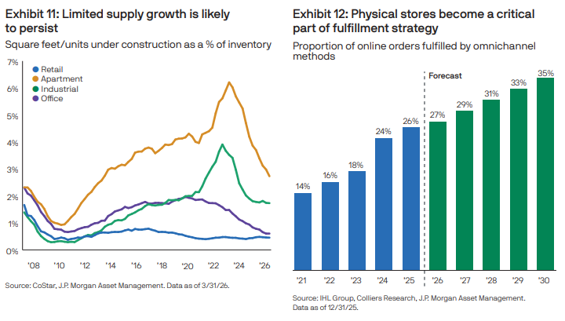
In retail, the omnichannel fulfillment narrative is growing and roughly 25% of online orders are now fulfilled through physical stores. That figure is projected to increase to over one-third by 2030.
- Rather than displacing stores, online sales growth has made well-located retail more valuable as part of an omnichannel network.
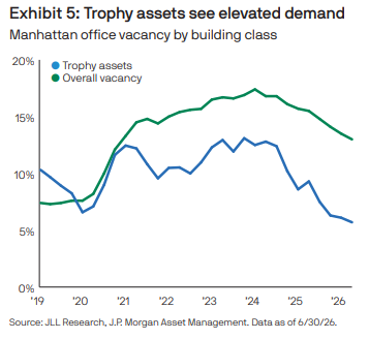
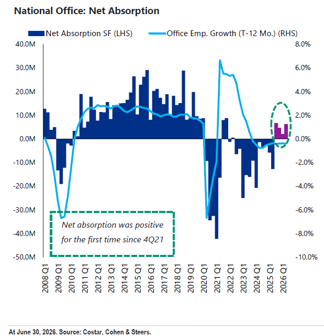
In office, over the last year, absorption accelerated. And while the Bay Area and Manhattan were getting the most attention, the recovery is now broad-based.
- The rebound is most evident in high-quality assets.
- According to Cohen & Steers, companies are leasing less office space but are paying more per square foot for new office space.
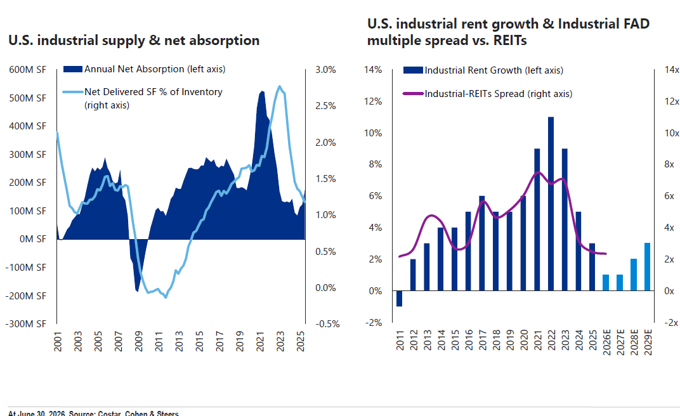
Industrial is experiencing early signs of stabilization, while moderating development completions are beginning to improve supply-demand conditions.
- National security priorities are pushing critical manufacturing back onshore, creating a new and durable source of industrial demand.
Economic Calendar: Week Ahead (Eastern Time)
Tues, 9/1 @ 9:45 am: U.S. Manufacturing PMI
@ 10:00 am: ISM Report On Business Manufacturing PMI
@ 10:00 am: Construction Spending
@ 10:00 am: Job Openings and Labor Turnover Survey
Wed, 9/2 @ 8:15 am: ADP National Employment Report
@ 10:00 am: Factory Orders
@ 2:00 pm: Federal Reserve Beige Book
Thur, 9/3 @ 8:30 am: Weekly Jobless Claims
@ 8:30 am: U.S. Trade Balance
@ 9:45 am: U.S. Services PMI
@ 10:00 am: ISM Report on Business Services PMI
Fri, 9/4 @ 8:30 am: Employment Report
@ 8:30 am: Unemployment Rate
@ 8:30 am: Avg Hourly Earnings, M/M%, Y/Y%
The Team Behind Friday Focus

Mary Ahn
Investment Research and Portfolio Strategy Manager

Cal Jones, CFA
Managing Director of Fixed Income

Eric Speron, CFA
Managing Director of Equities

Alton Tjahyono, CFA
Sr. Investment Strategist