

6 minute read
Smart insight and clear visuals that matter – what we’re watching now and how intention and conviction shape our portfolios.
Stock Market
U.S. Payrolls rose 172,000 in May, far above the 80,000 Dow Jones consensus, and a good sign of economic health. Oppenheimer reported overnight that tech industry layoffs were the highest in two years, last month, so job expectations are headed down which made a particularly bad impression on the market, off 105 basis points as of this morning.
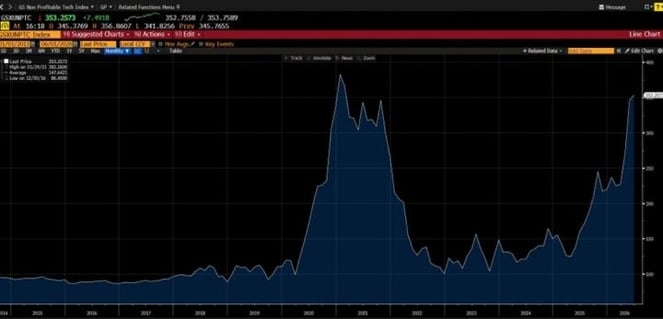
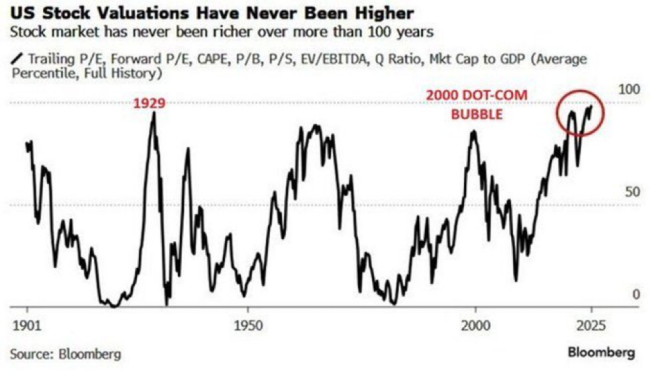
If jobs remain positive, rates likely won’t go down and the two charts below illustrate the risk - high valuations.
- Goldman Sachs chart depicts an index of unprofitable tech companies. It surged 200% over the past year and is back to 2021 levels. 2021 was at the height of the Meme stock/Reddit craze – not particularly a sign of a healthy market.
Why did Google raise money this week?
- Bringing on equity, creates room for more debt.
- Berkshire is a part of your equity syndicate.
- The best time to raise capital is when you don’t need it. They have $200bn of cash on the balance sheet and last year did $150bn in EBITDA.
- Getting capital out of the market may be easier now than after SpaceX IPO.
- Bringing on cash is something their competitors may be forced to try but have less success doing.
- Raising money when valuations are high may be conservative in some circles but could be thought of as wise if the market were to pull back from current levels.
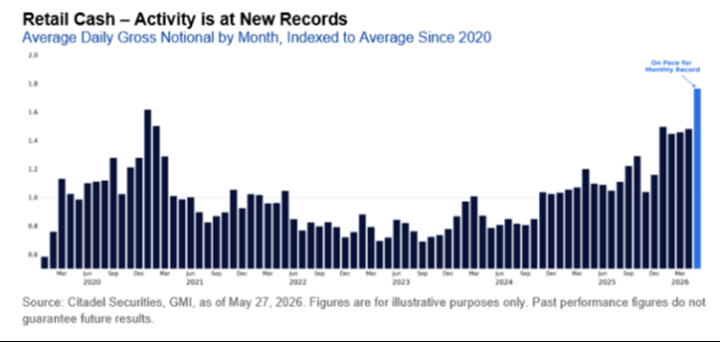
- Another illustration that retail may be overly engaged in this market per Citadel Securities, “Retail traders are the new price setters in the market. May volumes across our retail cash equities and options platforms are currently tracking at record levels. Daily volumes on our cash platform are setting new highs and are on pace to finish nearly ~10% above the previous record established during the January 2021 meme-stock era.”
Source: Bloomberg
Inflation
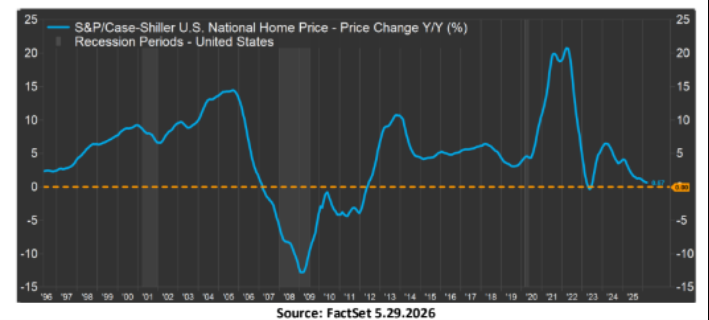
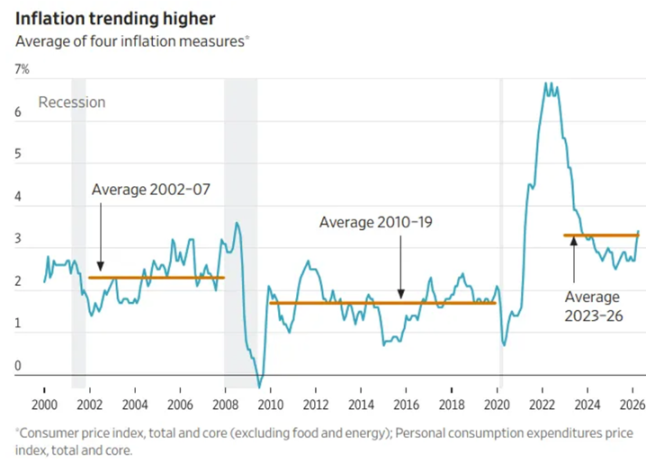
Investors continue to monitor more data to gauge if inflation will remain elevated from housing to global markets as the average inflation rate in the U.S. has remained stubbornly above the Fed’s target.
- Both the FHFA and Case Shiller home price data showed a marked slowdown in March, with both major home price indexes registering month-over-month declines.
- The Fed’s preferred gauge for inflation, core PCE, is in line with expectations on a year-over-year basis.
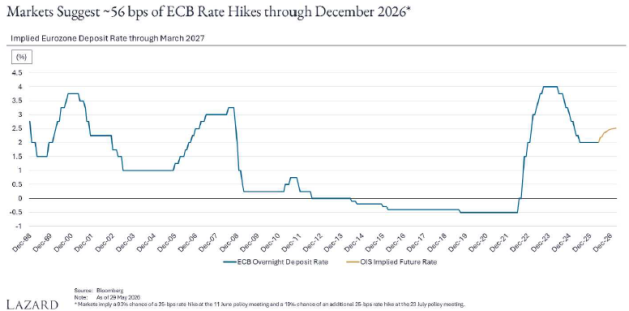
- Markets suggest a ~93% chance of a 25 basis points rate hike at the June 10th to June 11th ECB policy meeting.
- Eurozone inflation accelerated to 3.2% in May, remaining well above the ECB's 2.0% target. Further hikes may remain contingent on the Iran war.
Consumer Spending
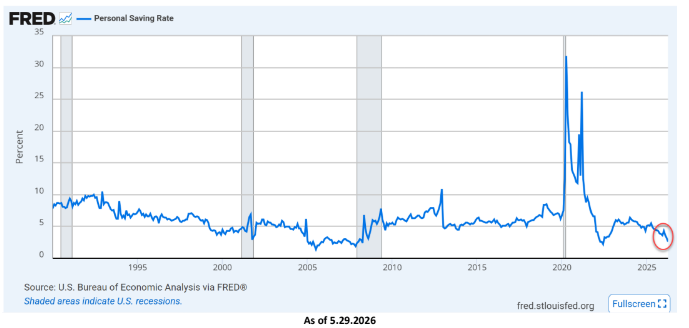
The U.S. national savings rate dropped to 2.6%, the lowest since 2022.
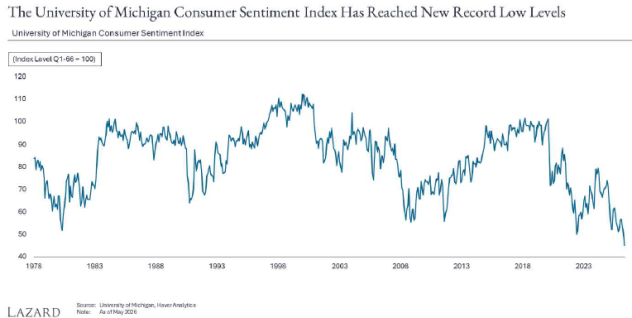
- The K-shaped economy continues to be a theme where low- and middle-income households are most negatively affected by rising energy and food prices. The University of Michigan reported that low-income consumers and those without college degrees posted strong sentiment declines.
- The U.S. consumer is increasingly reliant on the wealth effect of the stock market as income growth is basically zero and inflation is still elevated.
- While the U.S. manufacturing sector is booming (likely due to AI investments in data centers) the rest of the economy is looking colder than markets currently suggest.
Source: Goldman Sachs Global Investment Research and Goldman Sachs Asset Management. As of April 24, 2026. Chart shows the approximate pro-forma index weights of a hypothetical company with $1 trillion market cap floating 10% and 90% of its shares on the S&P 500, Russell 1000 Growth and Nasdaq 100 indices.
Tech
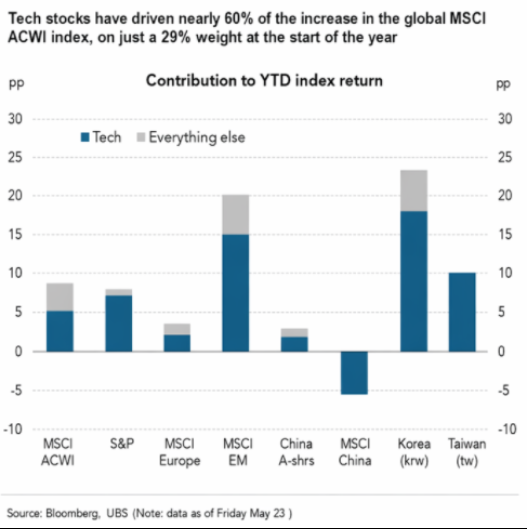
Tech now accounts for 42% in MSCI EM and 38% in the S&P 500. Tech stocks generated nearly 60% of the MSCI ACWI’s year-to-date returns, despite making up less than a third of the index when the year began. This concentration gets even wilder when you look closer home and abroad: tech alone is responsible for a staggering 88% of the S&P 500’s gains and 78% of Emerging Markets, where Taiwan and South Korea are being propelled almost exclusively by their technology sectors.
Even regions traditionally light on tech are getting swept up in the momentum. Take Europe as an example, where the sector accounts for a mere 7% of the total index footprint but has somehow driven 57% of its year-to-date performance. Across the globe, tech is the undisputed engine of this market. The lone, notable exception to this rule is China. While the rest of the world rides the tech wave higher, the MSCI China index has dragged its feet this year—pulled down heavily by the underperformance of its own tech giants, Tencent and Alibaba.
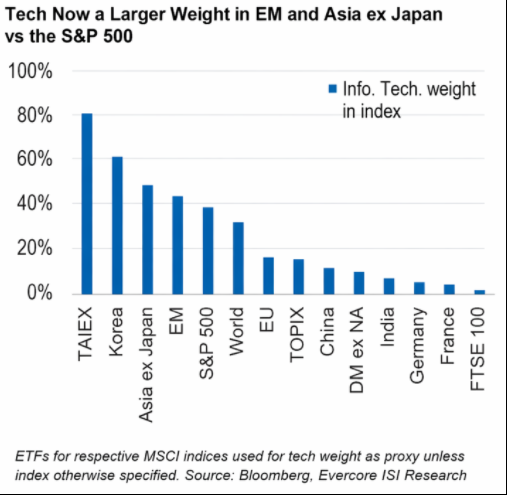
Source: Bloomberg, UBS (Note: data as of Friday May 23)
IPO: SpaceX
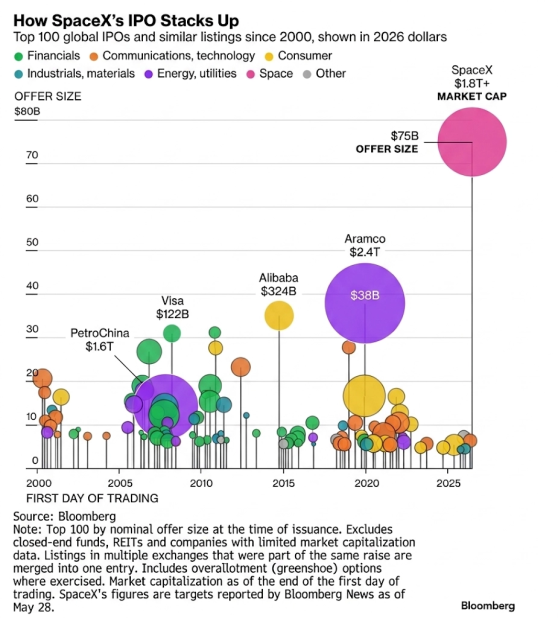
The impending SpaceX IPO could be shaping up to be the most consequential public debut in recent history because its success or failure could dictate the fate of the entire mega-cap listing pipeline. Seeking a record-breaking $75 billion capital raise at a valuation of at least $1.8 trillion, SpaceX could be forcing Wall Street's passive indexing and operational machinery to bend to its will. Because of this sheer size, the offering is likely serving as a critical bellwether for a long line of waiting private giants. With other massive companies like OpenAI and Anthropic currently queuing up for their own historic public debuts, SpaceX could be paving the operational road. If Elon Musk’s ambitious market-blitz succeeds, it could establish a frictionless template for these subsequent private titans to quickly relocate onto public exchanges. However, if the market ultimately rejects SpaceX's steep valuation and unconventional structure, market experts warn it could instantly staunch the flow of mega-IPOs and slam the door shut on Anthropic and OpenAI entirely.
Private Markets
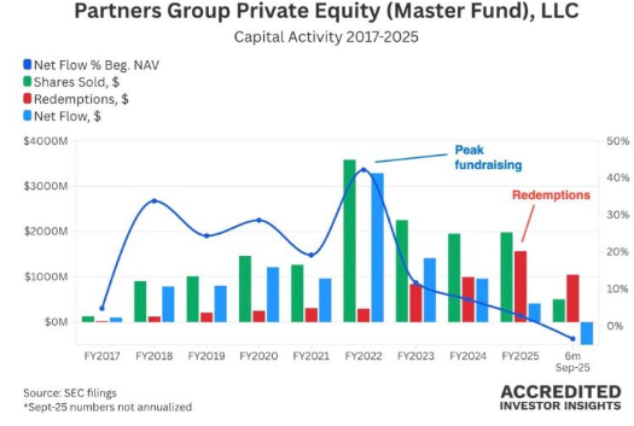
Private markets’ evergreen funds continue to hit redemption caps as investors are incentivized to queue to withdraw funds.
- Partners Group capped withdrawals at 5% of the fund’s value per quarter after redemption requests surged to 9.8% in the second quarter.
- Cliffwater’s flagship private credit fund redemption requests hit 17%. The fund restricted withdrawals to 5% of its outstanding shares.
- Blackstone has restricted withdrawals from its flagship private credit fund for the first time after redemption requests hit $4.5bn (10%) in the second quarter. The fund granted redemption requests amounting to 5% of its value.
Economic Calendar: Week Ahead (Eastern Time)
Tue, 6/9 @ 10:00 am: Existing Home Sales
Wed, 6/10 @ 8:30 am: Consumer Price Index
@ 8:30 am: CPI, YoY%/ CPI Core, Yoy%
@ 10:00 am: ISM Services
@ 2:00 pm: Fed Beige Book
Thu, 6/11 @ 8:30 am: Initial Jobless Claims
@ 8:30 am: Producer Price Index
@ 8:30 am: Ex-Food & Energy PPI, MoM%
The Team Behind Friday Focus

Mary Ahn
Investment Research and Portfolio Strategy Manager

Cal Jones, CFA
Managing Director of Fixed Income

Eric Speron, CFA
Managing Director of Equities

Alton Tjahyono, CFA
Sr. Investment Strategist