
6 minute read
Smart insight and clear visuals that matter – what we’re watching now and how intention and conviction shape our portfolios.
End of an Era
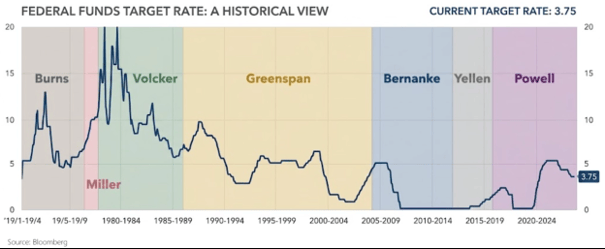
An era is coming to a close as Jerome Powell chairs his final meeting, expectations build around a potential transition to Kevin Warsh, and the Federal Reserve prepares for a possible new playbook. Powell’s departure marks an end of era defined by extreme transparency and a commitment to "gradualism.” By nearly any traditional metric, Powell’s tenure has been remarkable. He navigated the U.S. through a disruption that, in many ways, eclipsed the Global Financial Crisis. Under his watch, the S&P 500 climbed from 2,650 to 7,165, while U.S. GDP expanded by over 50%, $20 trillion to $31 trillion. Unlike his predecessors, Janet Yellen and Ben Bernanke, Powell was forced to manage two distinct economic cycles within a single term. His legacy is one of crisis management, preventing contagion during the 2023 banking failures, and maintaining generational lows in unemployment despite the most aggressive tightening cycle in forty years.
However, this growth came with a structural trade-off. By effectively putting a "hard floor" on yields during the depths of the pandemic, the Fed may have mathematically mandated the current upward pressure on rates. With 10-year yields finding a new home above 4%, the market is now adjusting to a "higher-for-longer" reality where inflation remains stubbornly anchored above the 2% target.
Kevin Warsh’s entry signals a move away from the Powell-era consensus. The era of the "Fed Put" and predictable, forward-guided gradualism is sunsetting. In its place, we could see the emergence of a central bank more comfortable with market volatility and less inclined to intervene at the first sign of a slowdown.
International Developed
Japan Shareholder Distributions
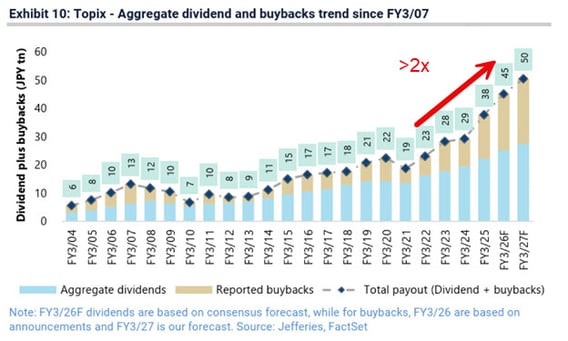
The changing approach of Japanese corporates is a large component of why we have dedicated Japan exposure in one of our models. This Jefferies chart is a great summary of the total amount of dividends and buybacks in the Topix Index.
Tech
The AI Pivot
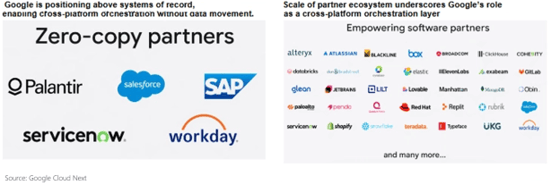
AI narrative in software is moving fast, but the real battleground is shifting from model innovation to orchestration - how models, data, and workflows are actually put to work inside the enterprise. If the first wave of AI was about the "brain," the second wave is about the "nervous system." Last week’s Google Cloud Next highlighted a fundamental shift in the software battleground: the focus has moved from model discovery to “architectural orchestration.”
With the launch of Gemini Enterprise, Google signaled that "better models" are now table stakes. The real frontier is making AI functional across enterprise workflows through agent-driven platforms. This "harness layer"—the software that connects data to decision-making—is becoming the primary site of vendor lock-in. For investors, this marks the emergence of a new moat. As raw models begin to commoditize, the durable value is migrating toward verticalized platforms that can govern, secure, and automate agent-driven workflows at scale. The winning pitch is no longer "our model is smarter," but "our system is more usable.”
Beyond the GPU
The Structural Re-Rating of the CPU Renaissance
For the past several years, the "AI trade" has been synonymous with the GPU. However, as we move through the first half of 2026, a fundamental shift in AI architecture is forcing a significant re-evaluation of the semiconductor landscape. While Wall Street remains focused on the raw compute power of accelerators, a new bottleneck has emerged: the CPU-driven orchestration required for Agentic AI.
The Shift from Training to Agency
The first wave of AI investment focused on Large Language Model (LLM) training—a process characterized by massive parallel processing and high-bandwidth memory (HBM), where the GPU is king. But as the industry pivots toward Agentic AI—systems capable of independent reasoning, tool-use, and multi-step decision-making—the workload requirements are changing.
Agentic workflows are sequential. They require branching logic and system orchestration that GPUs are not designed to handle. In these new architectures, orchestration can dictate between 50% and 90% of aggregate system latency. Consequently, the historical data center ratio of one CPU for every eight GPUs is rapidly recalibrating toward 1:4, or in specialized high-agency environments, as low as 1:2.
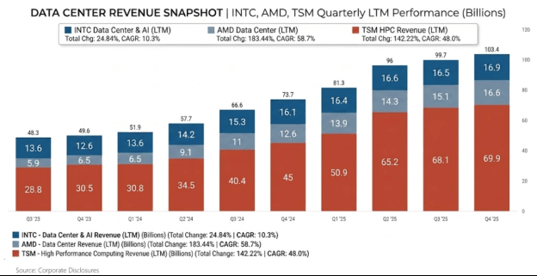
Intel’s recent Q1 performance serves as a bellwether for this "CPU Crunch." The company is beginning to see the dividends of its capital-intensive transition. This recovery is supported by a unique geopolitical and corporate alignment. Following the U.S. Government’s strategic 10% stake in August 2025 and a subsequent $5 billion anchor investment from NVIDIA, Intel has transitioned from a legacy processor manufacturer to a critical pillar of domestic hardware infrastructure. The recent partnership with TeraFab and SambaNova to build disaggregated architecture further cements the Xeon 6’s role as the primary engine for agentic tool execution.
The demand for next-generation CPU orchestration however is not limited to a single player, however, as the entire ecosystem is expanding to meet the requirements of the Agentic era.
Economic Calendar: Week Ahead (Eastern Time)
Tues, 5/5 @ 8:30 AM: U.S. Trade Balance
@ 10:00 AM: Job Openings
@ 10:00 AM: New Home Sales
@ 10:00 AM: ISM Services
Wed, 5/6 @ 8:15 AM: ADP Employment
Thur, 5/7 @ 8:30 AM: Initial Jobless Claims
@ 8:30 AM: U.S. Productivity
@ 10:00 AM: Construction Spending
The Team Behind Friday Focus

Mary Ahn
Investment Research and Portfolio Strategy Manager

Cal Jones, CFA
Managing Director of Fixed Income

Eric Speron, CFA
Managing Director of Equities

Alton Tjahyono, CFA
Sr. Investment Strategist