

7 minute read
Smart insight and clear visuals that matter – what we’re watching now and how intention and conviction shape our portfolios.
Markets
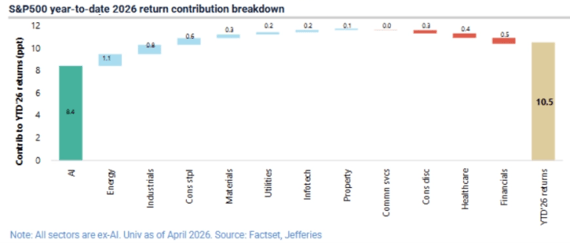
With Wall Street warning that the market rally has compressed into "one big trade," the staggering reality is that AI is driving roughly 80% of the S&P 500’s returns this year, underscoring an unprecedented era of hyper-concentration. The extreme reliance on a single structural theme leaves the broader market indices highly vulnerable.
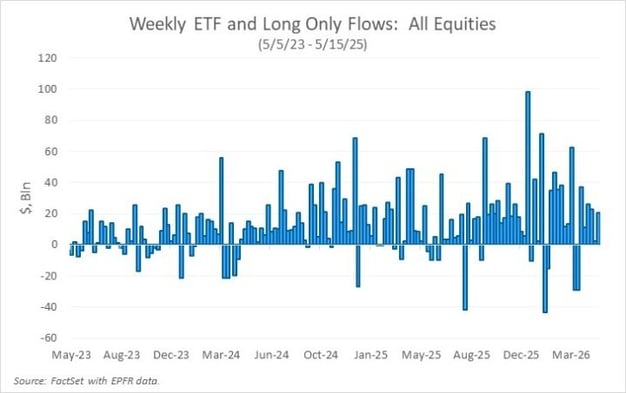
Flow data shows investors continue to allocate capital to equities. The below chart highlights persistent inflows, with only brief and limited periods of outflows, suggesting that retail and long-only investors have not meaningfully stepped back and when they do, it seems others have a “buy the dip” mindset. While this ongoing demand has supported the rally, it also reinforces the idea that positioning is becoming increasingly crowded, which can leave markets more sensitive to shifts in macro conditions.
IPO Market
The Multi-Trillion-Dollar IPO Rebound
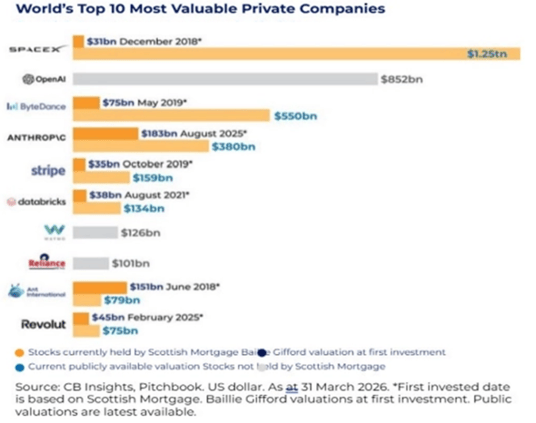
After a multi-year deep freeze, the IPO market is experiencing a profound regime shift. Capital is moving, valuations are recovering, and a generation of mega-cap private titans—SpaceX, Anthropic, and Databricks—are positioning for what could be the most significant public market debuts in history. The weakness in IPO markets since 2022 was not incidental – it reflected three structural forces that combined to compress activity well below historical norms.
-
The Rate Shock: Soaring interest rates closed the gap between private valuation fantasies and public market realities, aggressively punishing high-growth multiples.
-
The Speculative Hangover: Deep scar tissue from the low-quality 2020–21 IPO boom made public investors fiercely defensive and highly valuation-sensitive.
-
Private Capital Abundance: Late-stage private funding grew so deep that mature companies could comfortably delay public listings while still accessing billions in liquidity.
Now, those dams are breaking. SpaceX is targeting a June IPO that could raise between $75 and $80 billion, roughly double the total raised across all 2025 IPOs combined, at a valuation of up to $1.75 trillion to $2 trillion, according to Reuters. Anthropic and OpenAI are each eyeing listings that could raise $60 billion at valuations exceeding $1 trillion.
Calm Before the Storm
According to Bloomberg, Anthropic has been considering an IPO as soon as October—but before we get there, SpaceX is likely up first. The IPO kickoff is slated to start soon. From June 4th the roadshow is set to take a week until June 11th where they will target official pricing to open mid-morning June 12th. Remember this raise is only set to be ~$80bn which is microscopic relative to its rumored $2T listing price. This was a lesson learned from Saudi Aramco who IPO’d in December 2019 with an attempt to float 5% of the company but market conditions were not favorable, so they ended up getting just 1.5% of its total float out the door. Even today, just 2.5% of Saudi Aramco floats so there is a precedent.
Elon Musk released Form S-1 on Wednesday, May 20th, where he plans to float 4% of the company. Undoubtedly, this deal will likely be remembered as a defining example of the current financial era. Ahead of that, it’s worth pausing to note the growing concentration within the Nasdaq-100: the equal-weighted index is now near a record low relative to its cap-weighted counterpart.
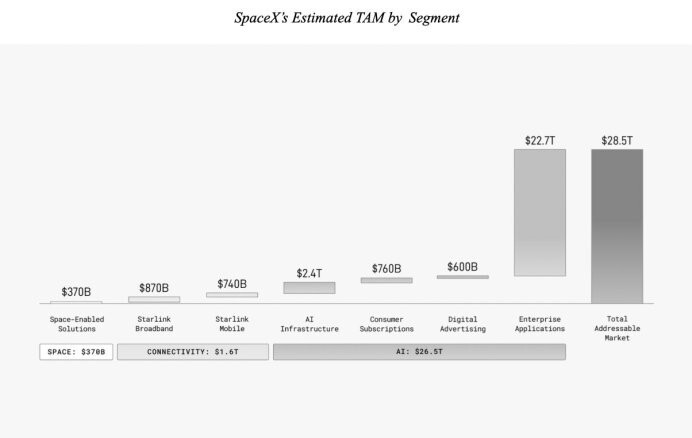
Elon is aiming to achieve a 92x revenue multiple, at the S-1 price of $1.75T. Beyond the index dynamics, the key question is how Elon supports his case, with the most ambitious total addressable market (TAM) anyone has ever seen. Elon’s target TAM is $26.5 Trillion, for reference, the global economy is ~$125T. To put that into perspective, $125 Trillion is $0.125 QUADRILLON – this makes becoming a millionaire seem very quaint.
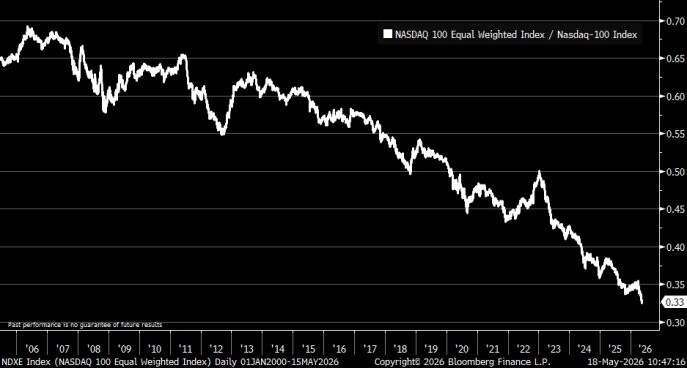
Source: Bloomberg
Source: SpaceX S-1
Prices
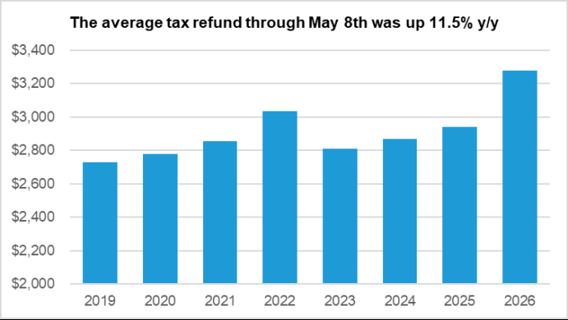
While gas prices are 50c from their all-time high entering Memorial Day weekend, consumer's pockets are a bit fuller because of tax refunds, which are up nearly 12% above last year’s levels according to Jefferies.
Source: Jefferies
Tech
Elon Musk has reportedly shifted near-term focus from Mars to the Moon, where resources like Helium-3—a potential input for quantum computing—are drawing increased attention. Notably, Helium-3 has been cited as extremely valuable, with estimates near $9 million per pound.
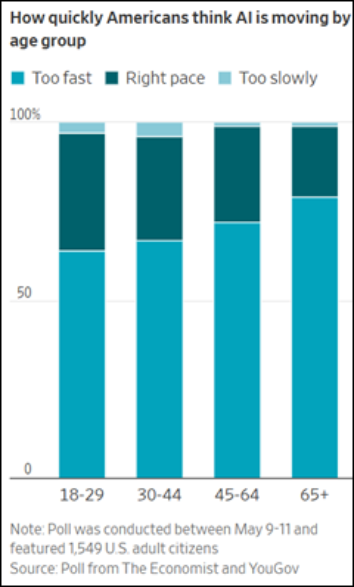
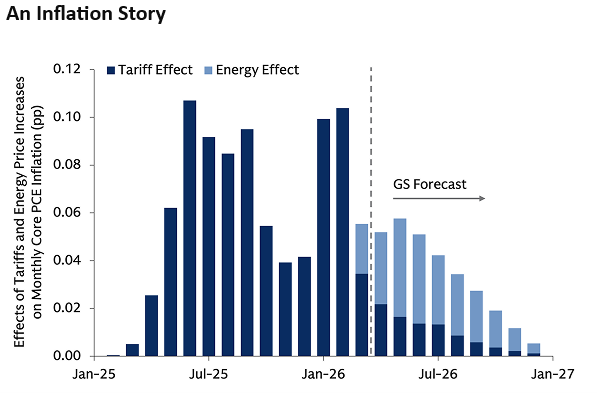
On Earth, exploration is underway in places like the Upper Midwest, tied to geological formations such as the Midcontinent Rift, but interest is also extending to the Moon, where governments and private players (including the U.S., China, and SpaceX) are actively exploring its potential. At the same time, domestic expansion of advanced computing infrastructure is facing growing resistance. The Wall Street Journal ran a report this week on the extent of that building opposition. Goldman has a chart showing that energy impacts are washing away in the coming months. Historical parallels have even been drawn to Luddite movements resisting industrialization. Luddites were a famous militant political movement of 19th-century English textile workers who violently opposed the progress of the Industrial Revolution, actively destroying factory machinery to protest job-displacing technology.
Regardless of the underlying cause, the impact is measurable: 48 data center projects (~$156B) were delayed or blocked last year, with 20 more canceled in Q1, due to backlash according to the WSJ.
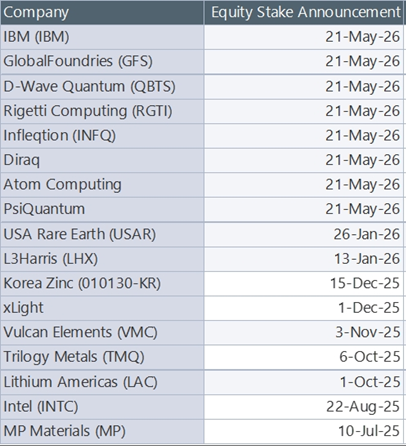
In response, the U.S. is attempting to offset these constraints through policy support, including ~$2B in recent quantum computing awards, alongside broader investment across semiconductors, critical minerals, and defense-linked technologies.

Source: Jefferies
Source: Goldman Sachs
Global Market
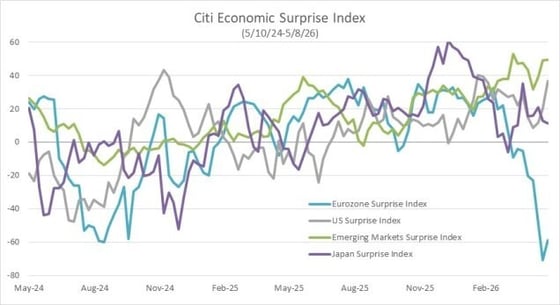
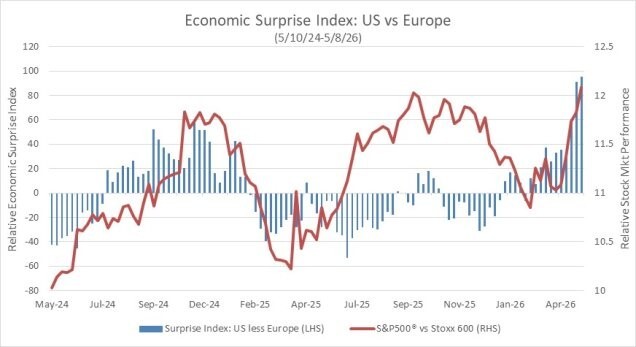
The Citi Economic Surprise Indices, which measure data surprises relative to market expectations, has shown meaningful changes globally that have been reflected in region specific equity indices.
- Europe's structural reliance on imported energy makes its economy more volatile and susceptible to inflation and surging production costs.
- European benchmarks are heavily weighted toward traditional sectors like financials, industrials, consumer goods, and energy. These sectors are highly sensitive to global economic slowdowns and trade frictions.
Source: Bloomberg
Source: Bloomberg
Economic Calendar: Week Ahead (Eastern Time)
Tues, 5/26 @ 9:00 AM: S&P Case-Shiller Home Price Index (20 cities)
@ 10:00 AM: Consumer Confidence
Thur, 5/28 @ 8:30 AM: Initial Jobless Claims
@ 8:30 AM: Durable-goods Orders
@ 8:30 AM: Durable-goods minus transportation
@ 10:00 AM: New Home Sales
Fri, 5/29 @ 8:30 AM: GDP (Second Revision)
@ 8:30 AM: Personal Income/Spending
@ 8:30 AM: PCE Index/ PCE YoY
@ 8:30 AM: Core PCE Index/ Core PCE YoY
@ 8:30 AM: Advanced U.S. Trade Balance in Goods
@ 8:30 AM: Advanced Retail Inventories/ Advanced Wholesale Inventories
@ 9:45 AM: Chicago Business Barometer (PMI)
The Team Behind Friday Focus

Mary Ahn
Investment Research and Portfolio Strategy Manager

Cal Jones, CFA
Managing Director of Fixed Income

Eric Speron, CFA
Managing Director of Equities

Alton Tjahyono, CFA
Sr. Investment Strategist