
6 minute read
Smart insight and clear visuals that matter – what we’re watching now and how intention and conviction shape our portfolios.
Economy
Bad is the New Good
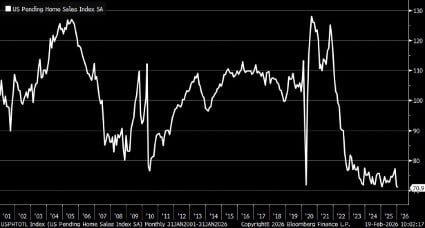
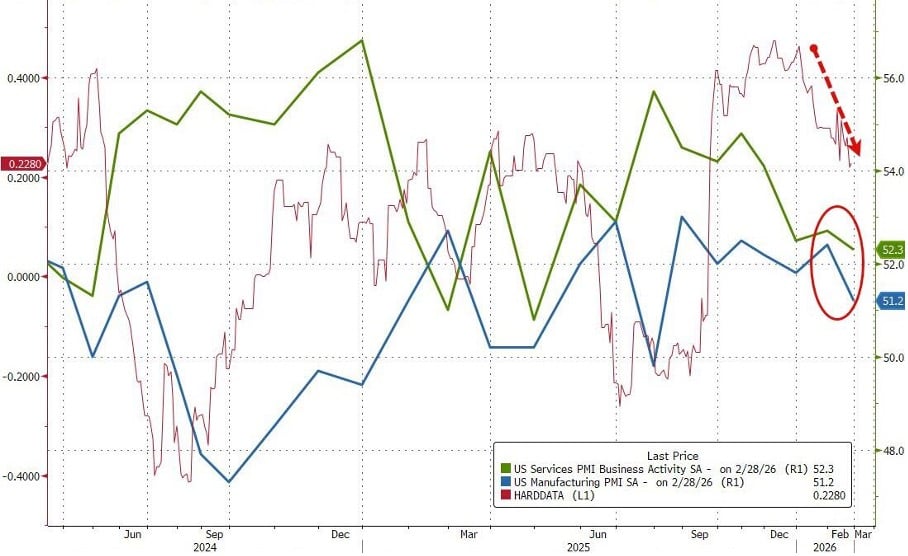
Bad news is good this morning with an ugly GDP print giving the Fed more room to cut rates! The housing number of pending home sales earlier in the week didn’t hurt either as pending home sales fell to an all-time low in January. We also saw weakness in the February PMIs where both Manufacturing and Services PMIs dropped notably:
- Flash US Services PMI Business Activity Index: 52.3 (January: 52.7). 10-month low.
- Flash US Manufacturing PMI: 51.2 (January: 52.4). 7-month low.
Source: Bloomberg
Interest Rates
Wednesday’s Fed minutes caught markets off guard, not because policy is changing, but because the language is. For the first time in some time, the forward guidance read more symmetrically. Notably, “several” participants acknowledged the possibility of rate hikes should inflation remain persistently above target. Is the Fed actually contemplating hikes? In a word: No.
There is little evidence that anyone on the FOMC genuinely expects to raise rates from here. But the Fed has long believed it exerts outsized influence over inflation expectations, and the logic is straightforward: if expectations help shape realized inflation, then signaling a willingness to hike, even hypothetically, can help anchor those expectations. As long as the threat remains theoretical, the Fed incurs little cost in floating it.
In that sense, the read from yesterday’s minutes is less about policy intent and more about narrative management. Looking ahead, incoming Chair nominee Kevin Warsh is likely to prove more receptive to deeper cuts—consistent with the emerging AI-driven deflation narrative and the Trump Administration’s call for a 1% funds rate. That said, even if leadership shifts, it is unclear how quickly consensus can form or how much latitude the Chair will have to materially redirect the committee. Practically speaking, a meaningful policy response still appears unlikely for at least the next several months unless something big happens.
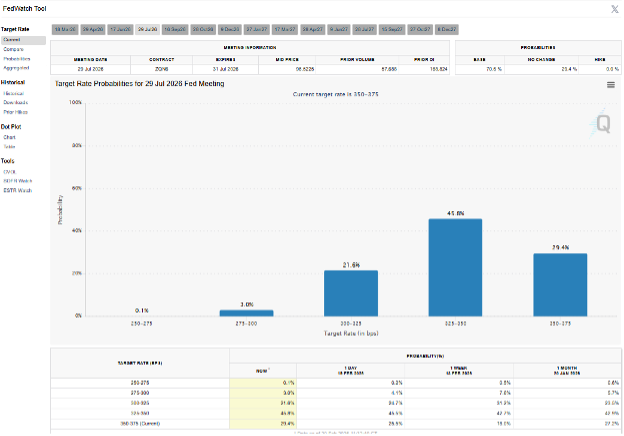
CME FedWatch shows majority consensus in no rate change for the near term, March (96%) and April (82%). June and July, we see sentiment shift to higher probability of a rate cut.
Tech
A Different Perspective on AI CapEx Boom
We have shown AI capital expenditures in a multitude of different ways.
Quick recap:
- Amazon planning ~$200B in CapEx.
- Alphabet will spend ~$180B.
- Roughly ~$700B in total AI-related investment expected this year (market estimates).
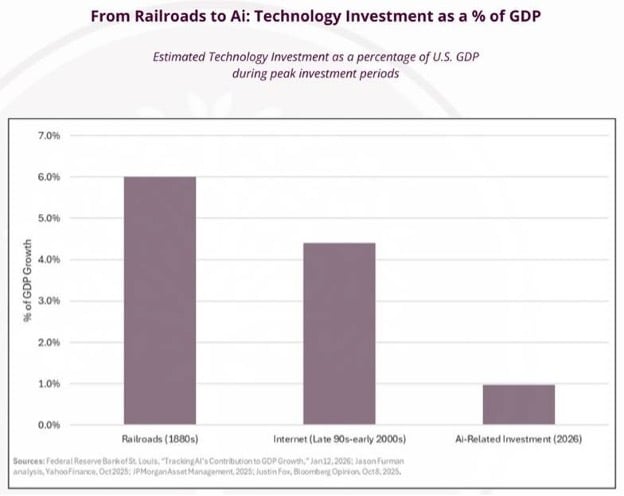
The spending numbers are large, to be sure. But does this spend indicate a peak? We do know it is sucking capital out of the rest of the economy, but it is hard to say if it is a peak so I thought this historical context would help.
At peak buildout:
- Railroad CapEx reached ~6% of GDP
- Internet infrastructure hit ~4% of GDP
- AI investment today sits at ~1% of GDP. There is nothing to say that those weren’t excesses, and economies are larger and more dynamic, but the AI investment cycle may still have meaningful room to run if there is an economic return to be had or if those spending levels are ready to reach the heights of previous manias.
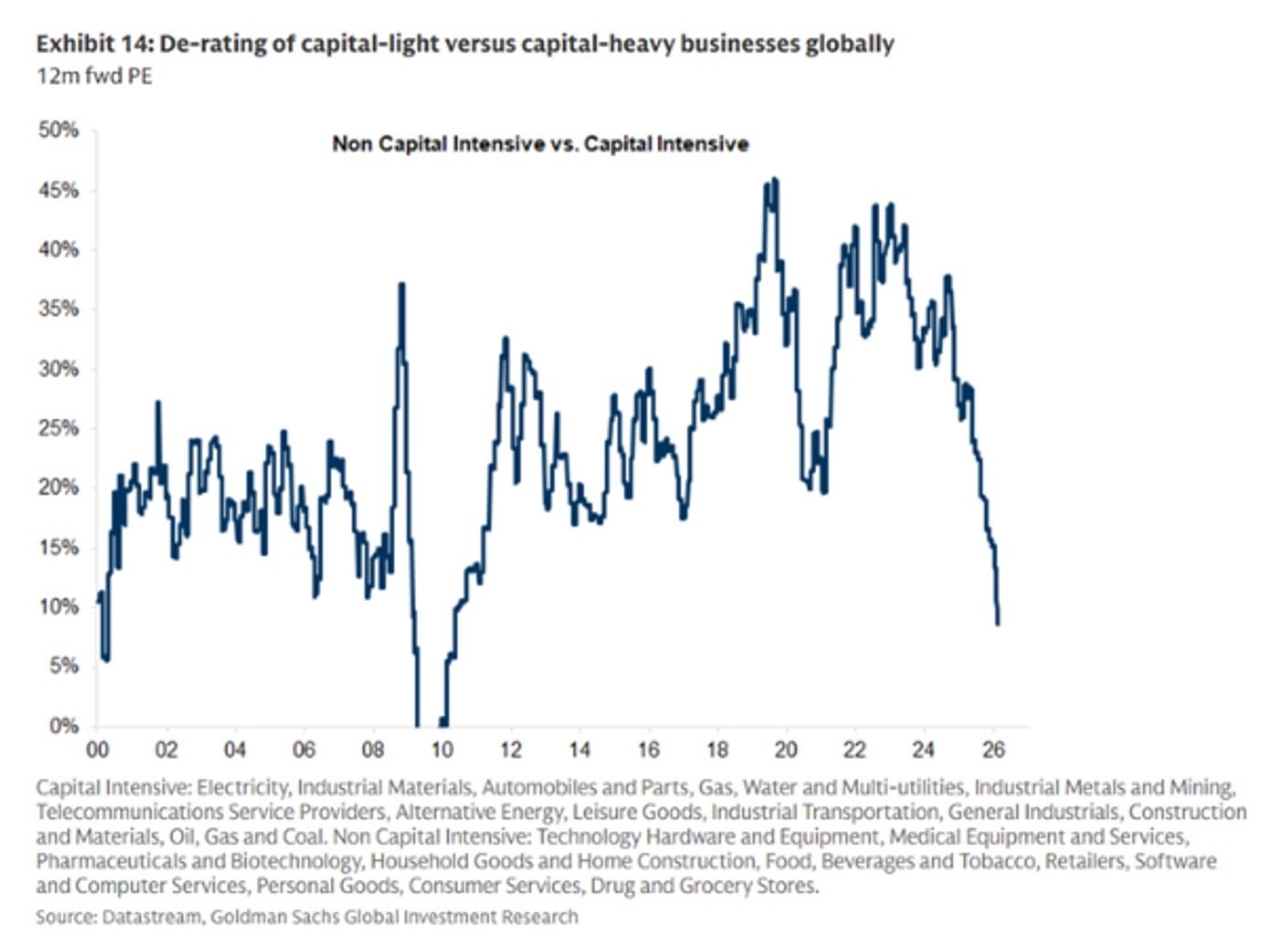
The Beneficiaries: We have said many times in the past 6 months that the beneficiaries may not be who you think as it looks like AI is deflationary to the digital world and inflationary to the physical world, the market is starting to agree according to Goldman Sachs.
High Yield Bonds
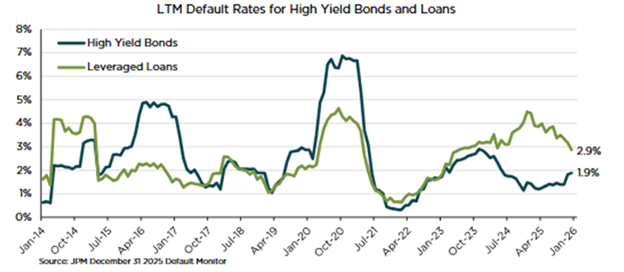
After three years of spread tightening (since 2022), we enter 2026 in a transitionary period with cracks beginning to form in markets (equity and credit). It is too early to say we are firmly “late cycle”, but we are clearly transitioning away from “mid-cycle”. When we look at default rates over the last 12 months, there was an uptick in bond defaults in 2025, while loan defaults decreased from a high of 4.5% to 2.9% today (25 year average default rate is 3.4% and 3% for bonds and loans, respectively). Hence, with record-tight “credit spreads” and an equity market with frothy valuations, HY will have difficulty outperforming meaningfully given the lack of available spread compression. Our base case is that high yield delivers a 5-6% return (starting yield with some disruption). Risks from inflation, geopolitics, or government policy could cause spreads to materially widen at which point investors are likely to look back and harken they should’ve known better.
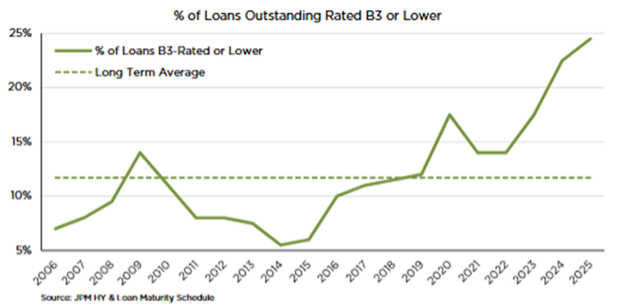
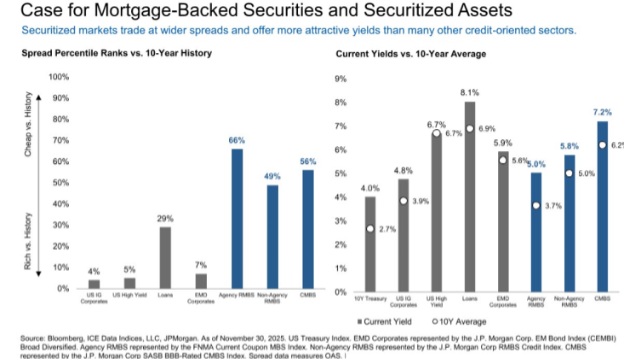
The housing related headlines point us to wanting to get long housing-sensitive sectors where HY Mortgages have a better likelihood of outperforming based on starting yields and duration. See River Canyon. Continuation of a weakening dollar has multi-sector/global funds being another area of interest. See Pimco Income. Ultimately, we think you can achieve better or at least similar outcomes with less downside risks in areas outside of Corp HY. Lastly, we would highlight again that with only a 10% likelihood of a March rate cut priced in and only 2 cuts priced for the year, maintain 5-7 yr duration rates look reasonably compelling to us, particularly on the back of the weaker labor market data and lower inflation. A 25 bp rally with 5‑year duration gives ~+1.25% price appreciation with a starting yield of 5% you are looking at 6.25% total return, slightly better than HY.
Tariffs
The Supreme Court has struck down a large portion of President Donald Trump’s tariff agenda, delivering a major rebuke of the president’s key economic policy. The law that undergirds those import duties “does not authorize the President to impose tariffs”, the majority ruled 6-3. The ruling is a big loss for Trump, who has made tariffs, and his asserted power to impose them on any country at any time, without congressional input, a central feature of his second presidential term. Trump’s legal stance would represent a transformative expansion of the President’s authority over tariff policy. The majority highlighted that Trump imposed tariffs without Congress, which has the power to tax under the Constitution.
According to Liberty Street Economics, the official economics blog of the New York Fed’s Research & Statistics Group, we ask how much of the tariffs were paid by the U.S., using import data through November 2025. 90 percent of tariffs’ economic burden fell on U.S. firms and consumers.
The chart plots U.S. Import tariffs by month in 2025. Blue dots depict average statutory tariff rate. Red dots show the average duty rate by month, calculated as total duties collected divided by the value of total imports. The average tariff rate grew from 2.6% at the beginning of the year to 13% by year-end.
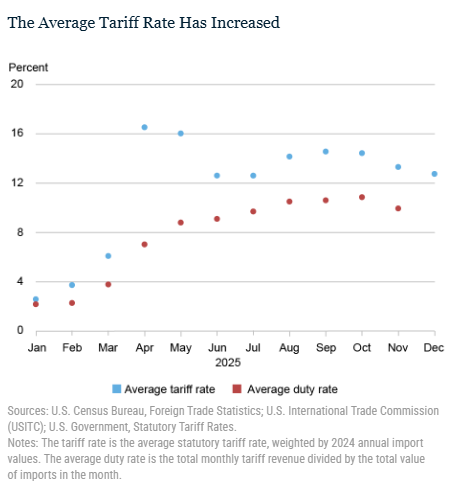
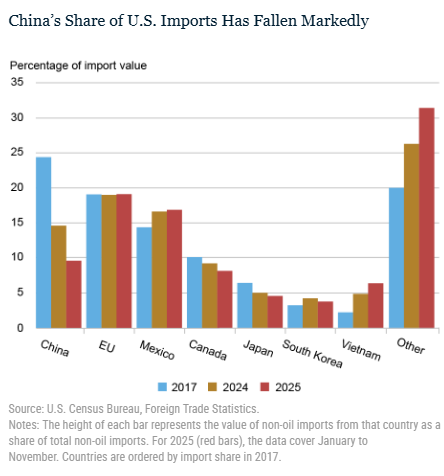
The difference between the statutory rate and the duty rate peaked in April and May, when importers shifted away from Chinese imports in order to avoid the higher tariffs levied on Chinese goods. Global supply chains shifted in response to the higher tariffs. Shares by country (or region) for 2017, 2024, and 2025, and countries are ordered by their 2017 import shares. These seven exporters accounted for approximately 80 percent of U.S. imports in 2017.
Tariff incidence is the technical term for how the costs of a tariff are split between foreign exporters and domestic importers. Past research found that foreign exporters did not lower their prices in 2018-2019, so the full incidence of the tariffs was borne by the U.S. That is, there was 100 percent pass-through from tariffs on import prices. The same analysis for the 2025 tariffs is conducted to show the following.
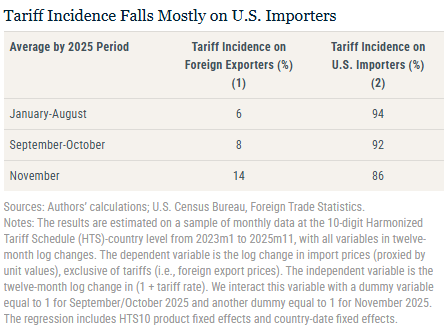
Higher import prices caused firms to reorganize supply chains and U.S. firms and consumers continue to bear the bulk of the economic burden of the high tariffs imposed in 2025.
Economic Calendar: Week Ahead (Eastern Time)
Mon, 2/23 @ 10 am: Factory Orders
Tues, 2/24 @ 900 am: S&P Case-Shiller home price index (20 cities)
@ 10 am: Wholesale inventories
@ 10 am: Consumer confidence
Thu, 2/19 @ 830 am: Initial Jobless Claims
Fri, 2/20 @ 830 am: Producer price index (delayed report)/ PPI YoY
@ 830 am: Core PPI/ Core PPI YoY
@ 10 am: Construction spending (delayed report)