

5 minute read
Smart insight and clear visuals that matter – what we’re watching now and how intention and conviction shape our portfolios.
Markets
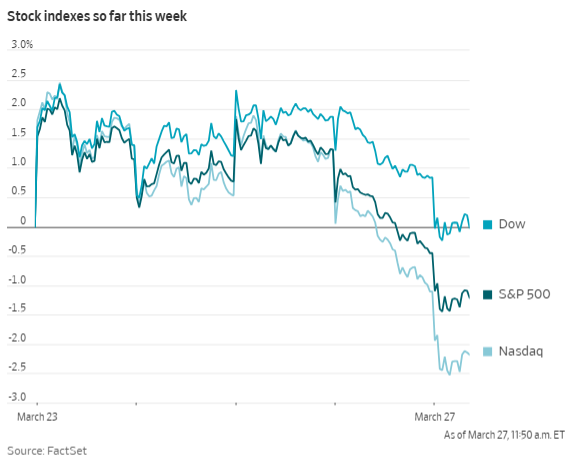
Stock indexes are down almost 2% today as Brent Oil trades above $110 a barrel. The S&P 500 is on pace to close lower for its fifth straight week, in what would be its longest weekly losing streak in nearly four years. Investors are cautious despite Trump’s pause on energy strikes to allow time for negotiations. The Wall Street Journal reported yesterday that “the Pentagon is looking at sending up to 10,000 additional ground troops to the Middle East to give Trump more military options even as he weighs peace talks”.
U.S. Dollar
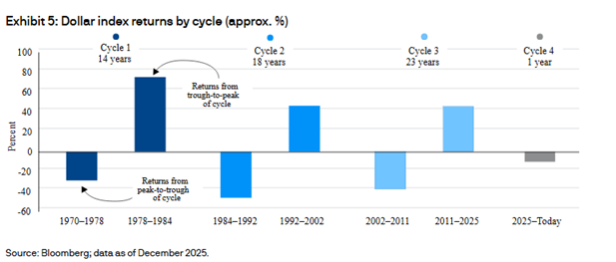
So much of the short-term outcome on the Dollar is premised on the war, longer term though it is a bit easier to see. We often speak about the duration of these currency cycles. Looking back to 1978, JPMorgan believes the “weak dollar cycle has just begun,” which is much too forceful of a statement to make about the dynamic markets we have today, but we just so happen to think they might be right.
Inflation and Rates
Pricing Persistence: The Death of the 2026 Rate Cut
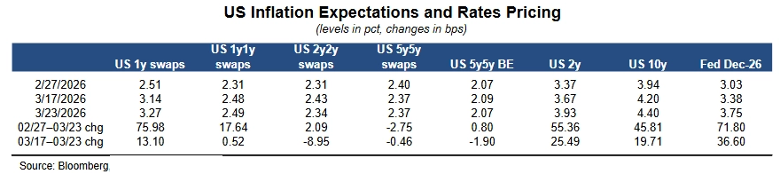
Sticky Inflation & Rates: Fears are mounting that inflation has found a "sticky" floor, driven primarily by ongoing attacks on oil and natural gas infrastructure across the Middle East.
The Death of the Fed Pivot
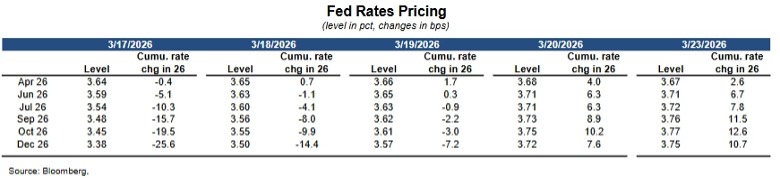
In a massive macro shift, markets have nearly priced out interest rate cuts for 2026. With all eyes on the war in Iran and its stagflationary implications, we had all major central banks meeting last week. As expected, the Fed, ECB, BoE, and BoJ all remained on hold. But the focus was on communication, with an across-the-board hawkish shift driven by the Iran war. Markets took notice, with zero cuts priced in for the Fed for the remainder of the year, and roughly three hikes priced in for the ECB and the BoE. Markets are pricing an inflation and a geopolitical shock, with a stronger US dollar and higher rates across the board. Equity markets have not taken as big of a blow thus far.
Yield Watch
Pre-Trump post market was pricing 4 hikes this year in the UK, close to 4 in the EuroZone and was leaning towards a hike in the US. Ten-year yields were at 5.1% in the UK, 3.1% in Germany, 3.9% in France and 4.4% in the US.
More on Inflation
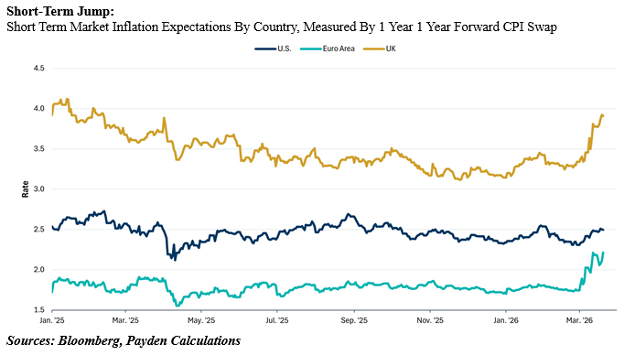
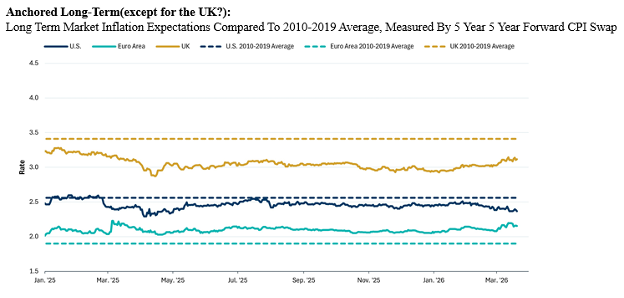
Payden & Rygel pointed out something one of our advisors also brought to my attention, that standard economic framework suggests current energy shocks are a “supply shock,” which central banks should “look through”. Raising interest rates could further impede supply-side responses, worsening the situation. Short-term inflation expectations have jumped; most gauges of longer-term inflation expectations remain well anchored. I think that point is valuable in a vacuum but Diesel at the cheapest gas station near me is $7/gallon. Trucks delivering auto parts, electronics, groceries, clothing, piping, pharmacy stock and more are all going up in price as trucks carry 70% of domestic freight by value, 64% by weight.
Fertilizer & Food Security
Beyond the gas pump, the Iran conflict has triggered a fertilizer price shock. The U.S. currently imports 35% of its total urea demand; with Middle Eastern supply lines disrupted, the U.S. is becoming uncomfortably reliant on Russian imports. While the Administration is looking to Venezuela to fill the urea gap via sanctions waivers, years of infrastructure degradation make a rapid production increase unlikely.
"Ships are the New Chips"
The war has exposed a critical vulnerability in global trade. 90% of goods move by sea and our system, built for "efficiency" via a few massive tankers, is proving brittle. The 60 Minutes exposé, "Turning the Ship Around," which aired on March 22, 2026, painted a stark picture of a U.S. shipbuilding industry in what it termed a "state of collapse", framing the decline not just as an industrial failure, but as a critical national and economics security risk. The report highlighted a staggering production disparity: China builds roughly 1,000 large cargo ships annually, while the U.S. produces maybe three. This "extinction" of commercial shipbuilding means that in a conflict, the U.S. would lack the merchant fleet necessary to sustain a war effort or maintain global supply chains if China were to weaponize its own fleet. Ships built in the U.S. currently take twice as long to construct and cost five times as much as those built in Asia (China and South Korea).
Software
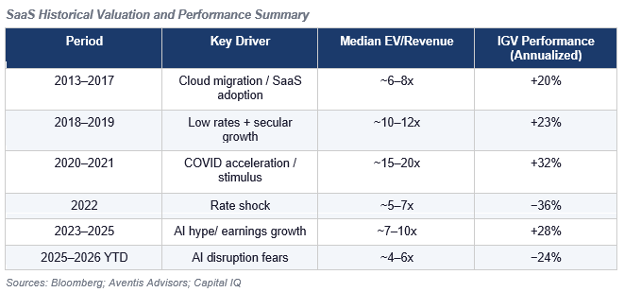
The table below illustrates the performance of software over the last decade and what it has been attributed to. Excluding the recent rise in bond yields, the main reason for multiple compression is the fears of AI disruption. We believe large cross sections of the software landscape are vulnerable but not all.
-
If you are a business that delivers a singular feature or something relatively simple, where a business can test whether they can use an LLM or a model to do the work better than the software, it is at risk.
-
The software companies that we believe aren't at risk and will thrive are those that provide tools that AI can leverage to deliver lower costs and/or more revenue.
Our research concludes that AI will be able to analyze whether it can write a better software tool, or if it should just use the efficient software tool a SaaS company has provided.
Apartment Rents
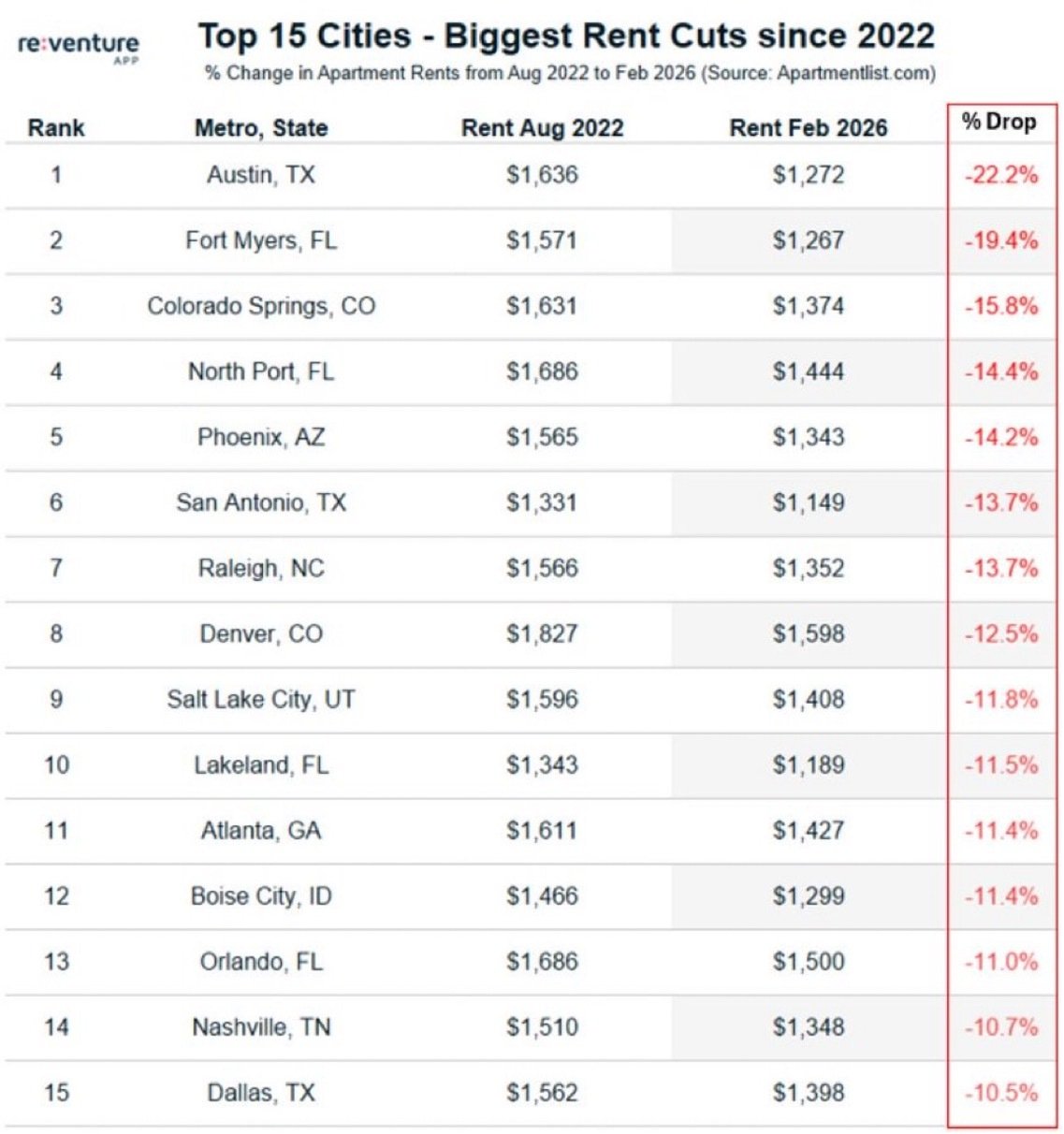
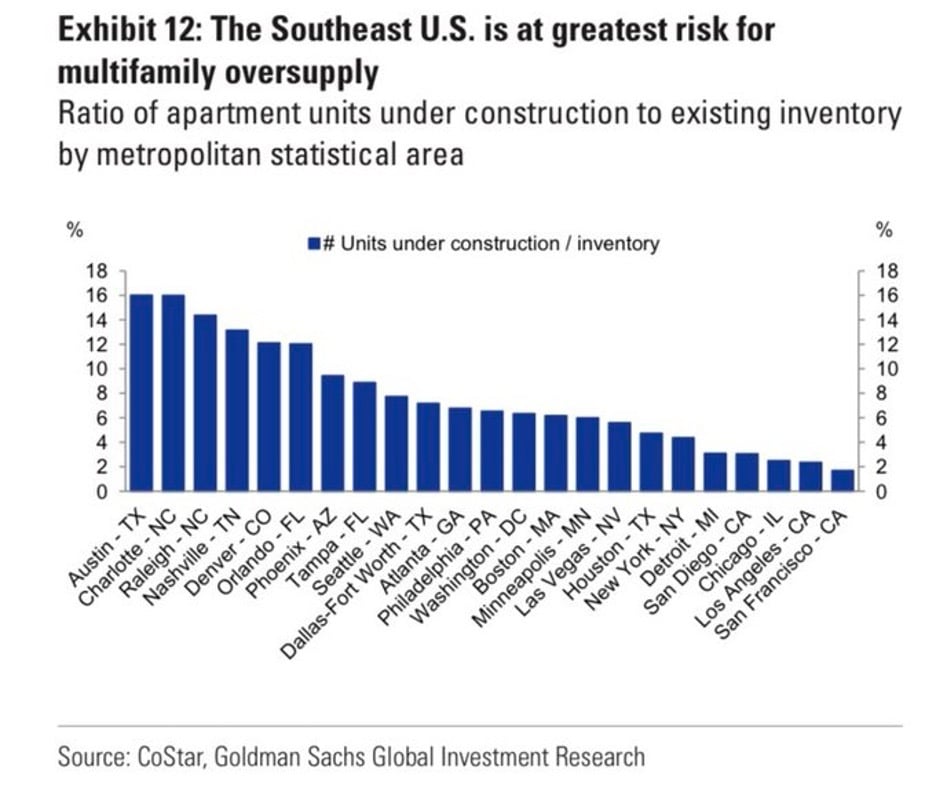
Real estate developers have overbuilt when money was cheap, in hindsight, it’s no surprise. However, what might inform you is where the overbuilt is concentrated. The table below looks a lot like a 2023 chart from Goldman where the number of units being put up are worthwhile comparison to where we are now seeing the largest cumulative rent cuts.
Economic Calendar: Week Ahead (Eastern Time)
Mon, 3/30 @ 1030 am: Federal Reserve Chair Jerome Powell speaks
Tues, 3/31 @ 900 am: S&P Case-Shiller home price index (20 cities)
@ 10 am: Job Openings
@ 10 am: Consumer Confidence
Wed, 4/1 @ 830 am: U.S. retail sales (delayed report)
@ 830 am: ADP jobs
@ 10 am: ISM Manufacturing
Thu, 4/2 @ 830 am: Initial Jobless Claims
@ 830 am: U.S. Trade Deficit
Fri, 4/3 @ 830 am: U.S. Employment Report/ Rate
@ 830 am: U.S. Hourly Wages
The Team Behind Friday Focus

Mary Ahn
Investment Research and Portfolio Strategy Manager

Cal Jones, CFA
Managing Director of Fixed Income

Eric Speron, CFA
Managing Director of Equities

Alton Tjahyono, CFA
Sr. Investment Strategist