

10 minute read
For much of the past several years, markets have been viewed through a narrow lens – sharply focused on a small group of dominant companies and themes that delivered outsized results. In 2025, that picture began to widen. Leadership broadened, international markets reasserted themselves, bonds regained relevance, and returns became less concentrated. As we look ahead to 2026, success may depend less on finding the single sharpest focal point and more on stepping back to see the full frame. A wider lens reveals rotation rather than reversal, opportunity beyond familiar names, and the importance of balance as rates fall and volatility returns to the conversation.
The S&P 500 finished 2025 up for the third year in a row. In the fourth quarter, the S&P 500 gained 2.7%, lifting its year-to-date return to 17.88%. There have been three other times when the market was up four years in a row, 1995-1999, 1982-1986, and 1942-1945; and only once five years in a row. The economy remained resilient thanks to strong consumer spending, lower inflation, and healthy corporate earnings and the stock market reacted favorably, hitting new highs.
While market performance was strong, returns were not evenly distributed, with a relatively small group of large-cap stocks accounting for a significant portion of the gains. The tech-heavy Nasdaq posted a 2.7% return for the quarter, lifted by the continued optimism and capital investment in cloud Artificial Intelligence and cloud infrastructure. For the year, the Nasdaq was up 21%. Large-cap growth stocks (Russell 1000 Growth) were up 18.6% while value stocks (Russell 1000 Value) were up 15.9%. Small-cap stocks (Russell 2000) had a positive quarter, up 2.2% and finished the year with a 12.8% gain.
International stocks meaningfully outperformed the U.S. for the first time in years. Developed market stocks (MSCI EAFE) gained 4.9% in the quarter, bringing the year-to-date return to 31.2%. Emerging markets rose 4.7% (MSCI EM) in the quarter, lifting the year’s return to 33.6%. The decline of the U.S. dollar (down 9.4% in 2025) during the year proved to be a meaningful tailwind for foreign assets.
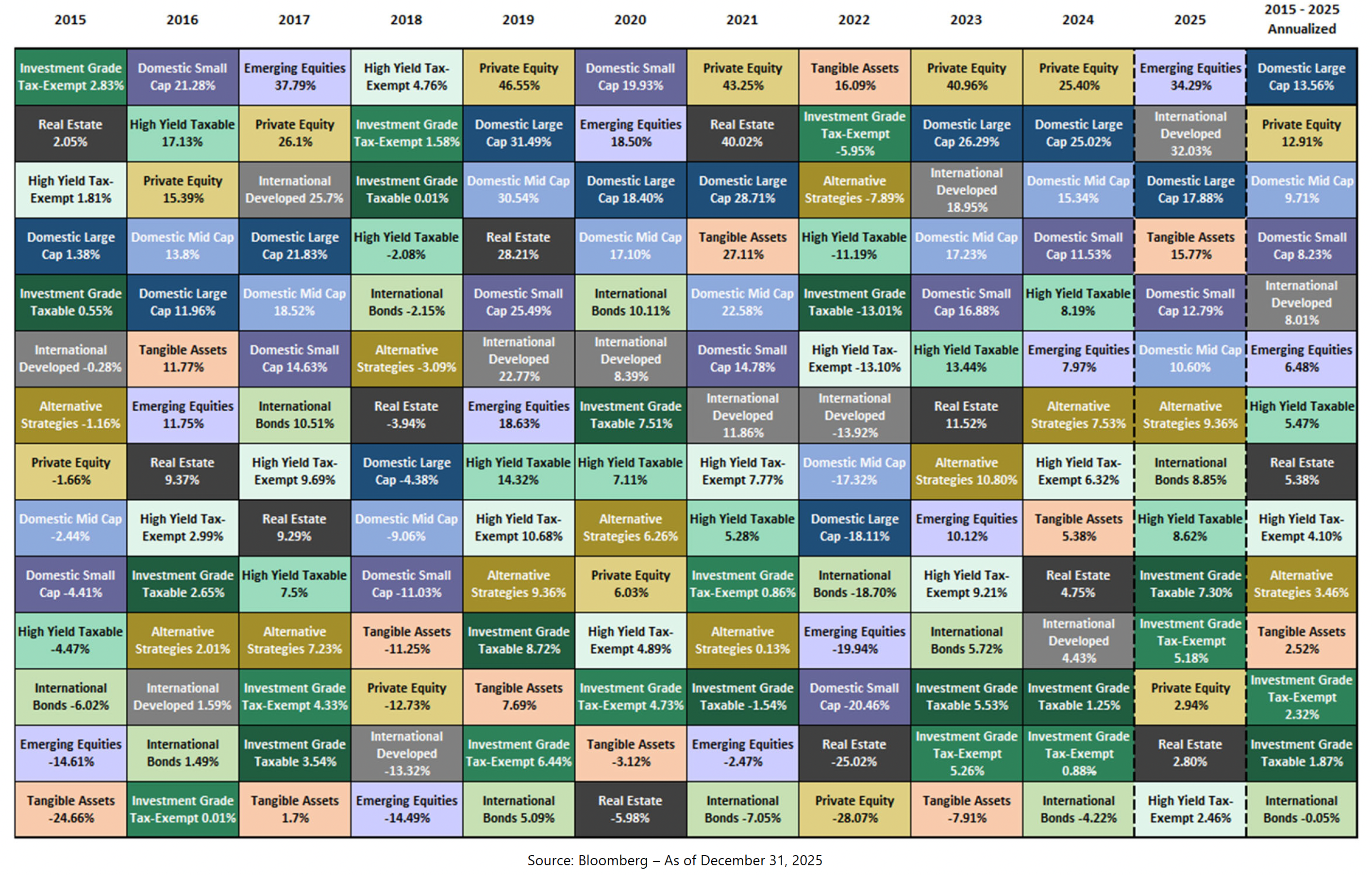
In the U.S. fixed-income market, the Fed cut rates by 25 basis points in December for the third time this year, bringing the Fed funds rate to 3.5%-3.75%. The Fed continues to emphasize data dependency, balancing the risks of elevated inflation and a tightening labor market. Against this backdrop, yields moved unevenly across the curve. Credit markets remained strong, with spreads near multi-decade tights, and fiscal pressures continue to influence long-term rates. Investment-grade core bonds ended the quarter up 1.1% (Bloomberg U.S. Aggregate Bond), while high yield bonds were up 1.3% (ICE B of A U.S. High Yield). U.S. core bonds had their best calendar year since 2020, returning 7.3% in 2025.
Investment Outlook and Portfolio Positioning
At the start of 2025, investor expectations were relatively modest, with many forecasters projecting U.S. equity returns in line with projected earnings growth of roughly 8% for the year. As the year unfolded, the market proved far stronger than anticipated, more than doubling start-of-the-year expectations. Our observations from last year were pretty accurate as the market returns broadened out and international led the way. We think the same trends driving the market will accelerate in 2026.
We expect GDP growth to be slightly higher in 2026, and it could surprise on the upside. The fiscal policies of Trump are expected to be more pronounced: lower taxes, incentives to invest in property, plant, and equipment, incentives to produce in the U.S., tariffs to move growth to the U.S., lower regulation, increase in defense spending, pro-energy production, more efficient government, AI and cryptocurrency low regulations, and bring prices down by increasing production.
Earnings are expected to accelerate from 11.5% in 2025 to 14.4% in 2026. All sectors are expected to be positive. We began to see the rotation in 2025 out of the Mag 7 into other sectors of the market. We believe that rotation will be a bigger driver in 2026. It will be difficult to surprise on the upside for technology stocks but much easier for other sectors with declining interest rates. What we’re seeing is not the end of leadership but the widening of the lens, with more sectors and styles beginning to contribute.
Another major factor is interest rates – the short end should continue to fall. With the Fed only signaling one cut (but we believe more are possible with lower inflation), energy will be a big help as well as lower rent and housing costs. Trump will focus on affordability, and housing supply will be a major initiative early in 2026. The demand for housing outstrips supply and there will be initiatives to increase supply. We think the Treasury Department may shrink the amount of the 10-year Treasury bond and buyback mortgage-backed securities to bring mortgage rates down.
The S&P 500 is trading over 22 times forward earnings, well above its historical averages. These higher valuations are being justified largely by expectations for continued economic growth and another year of double-digit earnings growth. We believe prices will be more sensitive to disappointments or changes and that could create volatility. We plan to take advantage of volatility and would not be surprised to see another decline like we did in 2025.
Go Global
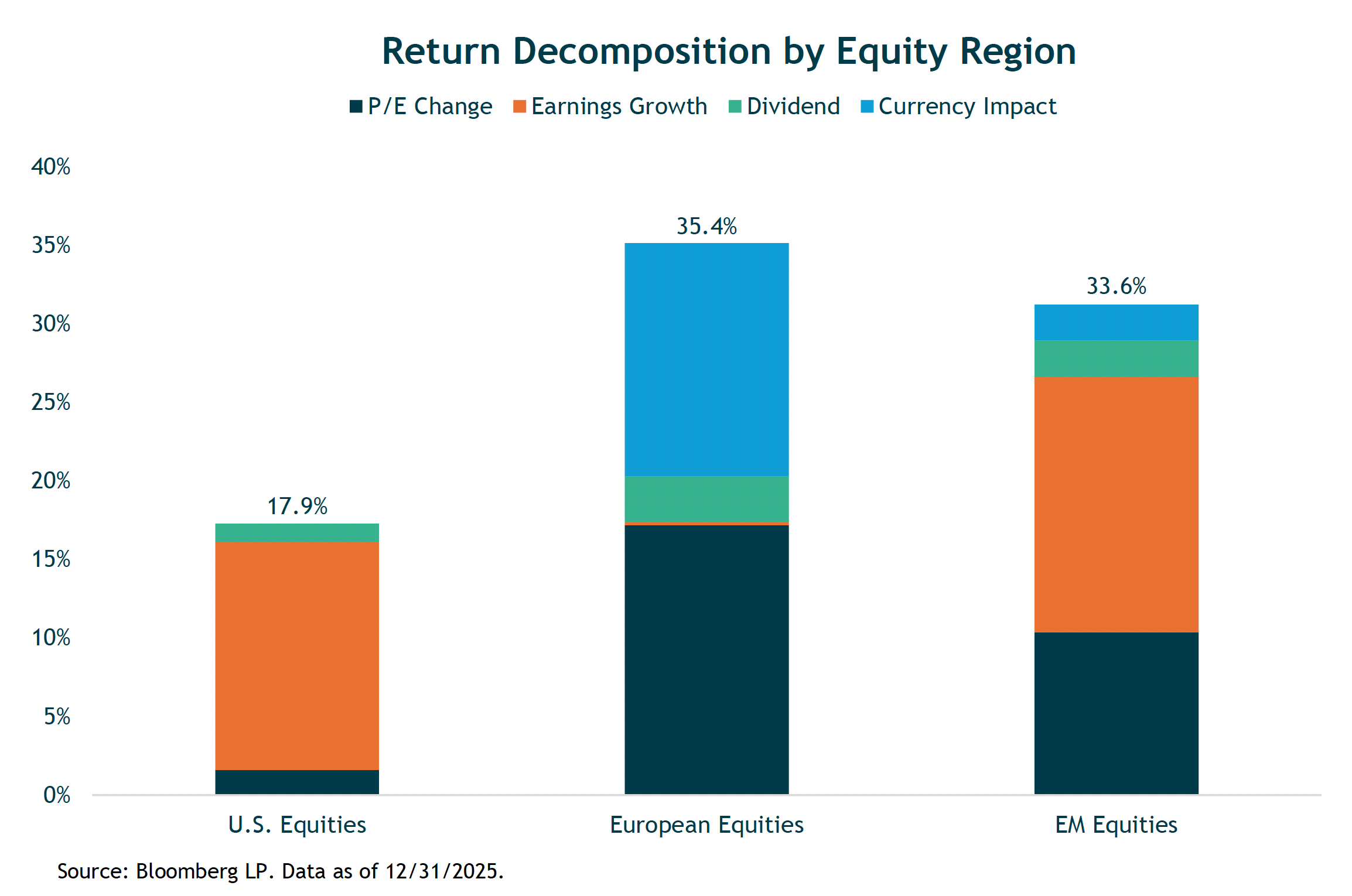
We have discussed international equity diversification for the past few years. For a while there, doing so often required saying “we’re sorry.” After last year, perhaps we can say “you’re welcome.” This year saw international equities outpace U.S. equities much like they did during President Trump’s first term in office in 2017. European equities gained 35.4% and emerging markets equities jumped 33.6% in U.S. dollar terms in 2025. The lion’s share of this outperformance relative to U.S. stocks occurred during the first quarter, aided by a significant depreciation of the U.S. Dollar relative to its international counterparts. Since equity markets bottomed in April following President Trump’s tariff announcement, U.S. stocks have largely kept pace with foreign stocks.
As we’ve highlighted in past commentaries, the U.S. dollar is a key factor in foreign equity outperformance. The ICE U.S. Dollar index fell nearly 10% in 2025 – providing a nice kicker on top of already strong foreign equity returns. The strength of the euro and British pound relative to the U.S. dollar was the culprit behind the dollar’s depreciation. MSCI Europe returned 20.6% in local currency terms – a figure modestly better than U.S. large caps – however, the decline of the dollar boosted MSCI Europe’s return to 35.4% in dollar terms. In addition to the dollar’s fall, European equity returns were driven by expanding price/earnings multiples. European earnings (in local currency terms) were essentially flat in 2025 – meaning valuation expansion and the dollar were the key drivers behind the strong performance. In contrast, emerging-market equity returns were more fundamentally driven. Valuations moved higher in emerging markets; however, earnings growth drove most of the 33% return. Emerging markets were powered higher by strong performance within the tech sector, and more specifically, a handful of AI-related names in Asia (such as TSMC, Tencent, Samsung, Alibaba, and SK Hynix).
Lower Rates Doesn’t Mean Higher Inflation
The Fed and monetary policy remain a key focus. The Federal Reserve cut rates three times during the year, and the FOMC’s current expectation is for one more cut in 2026. Given the strength of year-end economic data, we don’t believe we will see aggressive rate cutting in the early part of 2026. The FOMC’s single-cut expectations reflect caution about above-target (2%) inflation while acknowledging a softening job market. We expect more than a single rate cut in 2026.
We are not sold that a more politically driven Fed will automatically translate to higher long-term bond yields. Today, we are seeing longer-term interest rates being increasingly correlated to expectations for the future path of Fed policy. Therefore, if the Fed holds rates steady or cuts more than expected, longer-term yields could remain in their current range or move lower.
Lower interest rates do not guarantee higher inflation or higher bond yields. Historically, short-term rates are lowered amid sluggish economic growth, not during periods of strong economic growth. In the current environment, lower rates guarantee nothing more than they have in the past. For example, the past decade showed that extremely low interest rates alone did not cause inflation. In fact, many believed inflation was dead. That was until inflation reached roughly 9% in 2022.
As we have said in past commentaries, we think big swings in inflation levels have more to do with an imbalance of the supply of money (M2) and demand for money. This balance explains why inflation did not spike in the early stages of the pandemic when the government handed out trillions of dollars of stimulus. Despite trillions of dollars flooding into the economy, the increase in supply was met with proportional demand as the economy was shut down and consumers could not spend. When the economy reopened, “revenge spending” caused demand for money to plummet. This surge in spending led to a collapse in the money demand, amid high levels of money supply. The meaningful increase in inflation occurred because the supply of money far exceeded demand. Today, the supply and demand for money are back in balance. Our belief is that money growth has normalized, and the economy is not being overfed with liquidity, reducing the odds of inflation jumping higher.
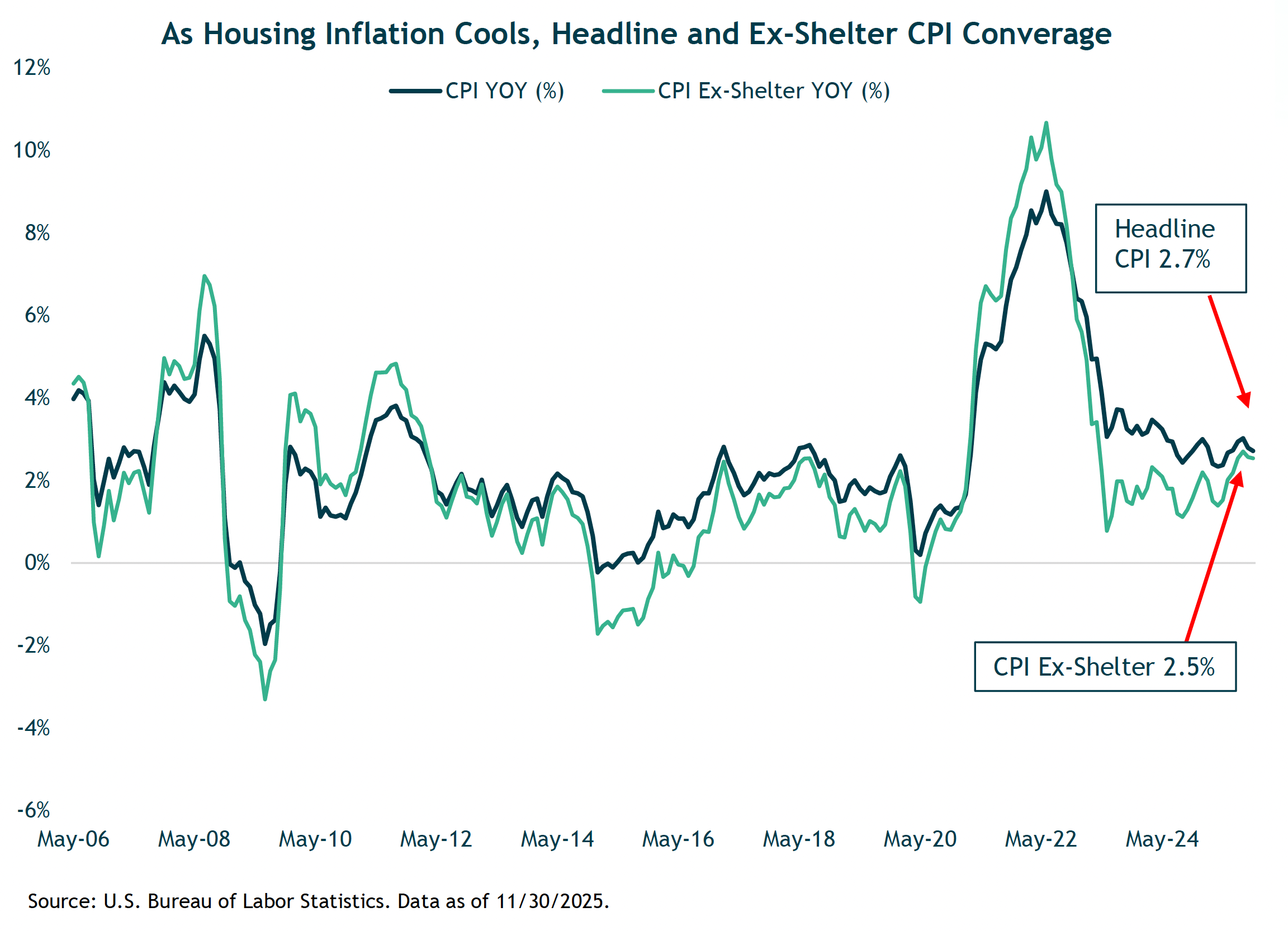
With liquidity not a driving factor, we think inflation is likely to trend lower in 2026. One key input to this view is the shelter (housing) component of inflation. We have argued for quite some time that the shelter component of inflation, which accounts for nearly one-third of CPI, has been inflated. The chart below shows headline inflation (CPI) and inflation ex-shelter. On the right-hand side of the chart, you can see the two measures diverged for the last two and a half years, but that gap has narrowed. Importantly, zooming in on the shelter component of inflation, or owner’s equivalent rent, over the past three months there has been a significant decline. Again, this is a meaningful component of CPI, so over the next nine months, this will work to lower inflation because CPI is a 12-month rolling measure where a new month of data replaces the older month, causing inflation to rise or fall as past inflation drops out and new data is added.
As for current bond yields, higher yields have improved the income potential of bonds compared to recent years. 10-year Treasury yields finished the year in the low-4% range (4.18%), offering decent levels of income while also providing diversification benefits within portfolios. Investment-grade corporate bonds continue to reflect strong credit quality, but credit spreads are relatively tight, limiting price appreciation in corporate credit. High-yield bonds also have compressed spreads, signaling investor confidence in the economic outlook and corporate balance sheets, but leaving less room for error should growth slow meaningfully or defaults rise, neither of which we see happening in the intermediate-term.
Our base case is that the yield curve will stay steep in 2026. As leadership broadens and the lens widens beyond equities alone, income once again becomes a meaningful contributor to total return. We think most of the steepening will come from the front-end moving lower. As of year-end, the Fed Funds rate range is 3.5%-3.75%. We think there will be more than one rate cut by the end of 2026, which seems consistent with slowing but decent growth, some weakening in the labor market, and inflation slightly above target but coming down. Longer-term yields will follow but not come down as much as shorter-term yields.
Alternatives
Widening the lens to include alternatives allows portfolios to benefit from assets that behave differently across market cycles. Alternatives provide powerful long-term portfolio benefits and non-correlated returns to traditional stock and bond holdings, and improve risk-adjusted returns of balanced portfolios. Given the current volatility in public equity markets, alternative investments have delivered good relative returns with low volatility just as we would have expected.
We favor private real estate investment allocations to multi-family, industrial, and self-storage, and selected grocery-anchored centers. We expect equity-like long-term returns from these investments with built-in inflation protection and tax-efficient income generation. Our real estate investments will also benefit significantly as the Fed cuts interest rates. We also favor private equity and credit opportunities. We believe alternatives tend to follow public markets and offer meaningful upside. We will continue to add alternatives to our diversified balanced portfolios and expect solid returns.
Closing Thoughts
Looking ahead to 2026, our outlook remains constructive with real GDP growth expected to range between 2% and 3%, supported by consumer spending and an ongoing investment cycle tied to infrastructure, energy, and productivity-enhancing technologies. While AI-related investment has been a major contributor to recent growth, we expect its pace to slow from the exceptionally fast levels. Importantly, the macro backdrop appears solid and lower rates will continue to drive corporate earnings.
We expect market leadership to broaden as the outsized performance of large-cap stocks begins to moderate. Smaller-cap and value-oriented segments are supported by earnings recovery, operating leverage, and more attractive valuations could attract interest as the economic growth story remains intact and financial conditions ease.
Credit fundamentals remain sound. Lower policy rates should ease refinancing pressures and support corporate balance sheets, with returns in fixed income increasingly driven by income with some modest price appreciation. A gradual steepening of the yield curve led by declining short-term rates would be consistent with slowing but healthy growth and inflation declining. Real estate and alternatives offer very attractive risk/reward characteristics in this type of environment.
This is a moment to stay disciplined. A wider lens reminds us that today’s crosscurrents are part of a larger, longer-term picture. Near-term volatility and policy noise will likely continue, but fundamentals are providing a constructive backdrop. We continue to maintain diversified portfolios, balancing risk and opportunity, and positioning to benefit from long-term secular trends while staying alert to evolving macro and policy risks.
We sincerely thank you for your confidence and trust in us. Please do not hesitate to reach out to us if you have any questions or wish to discuss how all this relates to your specific financial situation in more depth.